INDIVISIBLE Lambertville NJ / New Hope PA

Author: Indivisible Lambertville / New Hope

  • ILNH FYI

    ILNH FYI

    Join ILNH in the New Hope Celebrates Pride Parade!  Saturday, May 18 – Marchers meet on York Street between N. Union and Main St. in Lambertville at 11 am. Look for the ILNH crew and wear your rainbow ‘Vote’ shirts if you have them, or just wear the rainbow. We will have the big white truck again this year, but space is extremely limited and will only take those who have challenges making the trek through Lambertville and down S. Main, New Hope. Sign up on Facebook, and leave a comment if you need to ride.

    New Springboard event scheduled! Mark your calendars for June 3 to attend the Springboard on Dark Money. Heather Santos from America’s Promise will be our expert and speaker. Learn more about the work of America’s Promise and their efforts to make the 28th Amendment to get big money out of politics a reality. Location is TBD, so stay tuned!

    Support our Springboard partners and take action – ILNH has held three awesome SpringBoard events to date focusing on Immigration, Civil Rights and the NJ Budget. To hold these events, we rely on partner organizations for their expertise, and offer a means to amplify their work and support their organizations. Please consider taking on the calls to action or donating to these worthy organizations.

    If you live in New Jersey, call or write your three legislators and the governor. Residents of Lambertville, East or West Amwell, or the Mercer County municipalities of Ewing, Hopewell, Lawrence Township, Pennington, Trenton or West Windsor can find the contact info here:   https://ilnhclone.indivisible.blue/contact-state-level/.  If you live elsewhere in New Jersey, you can find your legislators for your municipality here: https://www.njleg.state.nj.us/members/legsearch.asp.

    Message:

    I support  A4743 / S3229, which expands access to driver’s licenses. This bill would make sure that more New Jerseyans, regardless of status, to be tested, trained, and insured for a driver’s licenses.

    It would create a safer New Jersey and allow residents to more fully engage in our economy and make our state stronger.

    Message:

    I urge you to support A-314 and S-3261 restricting the use of isolated confinement in correctional facilities. Isolated confinement causes lasting physical and neurological effects and PTSD. Your support in ensuring passage of this important legislation is necessary to effectuate meaningful and overdue prison reform.

    Message:

    I urge you to support the millionaires tax. Note: Senator Shirley Turner has endorsed the millionaires tax, write or call to thank her.

    • The millionaires tax would affect less than 1% of NJ residents.
    • It is supported by 70% of New Jerseyans.
    • The NJ Legislature already voted for the tax 5 times (and Christie vetoed it).
    • With the Trump tax scam, the richest 1% would still end up with a net tax cut, even with this tax.
    • Rich people will not leave NJ because of the tax.
    • The funds raised go into the Property Tax Relief Fund.

    Note: NJPP will hold their Tax Fairness Advocacy Training in New Brunswick on May 19, at 10 am. Sign up here:  https://njwec.salsalabs.org/taxfairnesstraining/index.html

    ATTENTION! JUNE COMMUNITY GATHERING –  The June Community Gathering will be held on Sunday, June 9, at the Lambertville Elks. The Elks building is around the corner from Cavallo Park where the “We Are One” picnic will be held the same day. The “We Are One” picnic celebrates the diversity of our community with music, food and childrens’ activities, and is organized by the Human Rights Council of Lambertville in partnership with Fisherman’s Mark. The picnic is held from 1-5 pm, so make plans to attend before or after you come to the Community Gathering.

    Civil Rights Action Group – Learn more about Mass Incarceration through Books and Movies – The group had a successful book drive for their Books through Bars initiative – see the pix of some of the members getting ready to deliver some of the collection. In addition, the group is convening their first Book Club meeting on Tuesday May 14th. Stay tuned for more information on more Book Club meetings and an upcoming screening of 13th – a film that explores the intersection of race, justice and mass incarceration in the U.S. at the Acme Screening Room in June.

    Indivisible Liberty T-Shirts are still availableIf you didn’t get one, or you know someone who’s coveted yours, both the red and green Lady Liberty versions are available in both men’s and women’s. Contact Cindi Sternfeld or pick one up at the Swag table at the Community Gathering.
  • Ready, Set, Elect! The New Jersey 2019 Election Schedule

    Contributed by Paige Barnett.

    The schedule for preparing the New Jersey primaries is in full swing.  Here are two very important dates to remember; Tuesday June 4th is the New Jersey Primary Election and Tuesday November 5th is the General Election. So what’s been happening?  

    Thus far, in the month of January, New Jersey saw the nominations to the County Board of Elections. In February, pursuant to N.J.S.A. 19:31-2, counties had to submit an “Evening Voter Registration Plan”  by County Commissioners of Registration to the Secretary of State. The month of March is when the Governor commissions the Election Boards and they begin to organize. This is also when the deadline must be met for creating, abolishing, dividing or consolidating an election district.  Also, the County Commissioner of Registration must publish the Notice of Requirements to Vote in a Primary Election. The Secretary of State must also submit a notice to the County Clerks and County Boards of Election of available offices and any public questions for the upcoming general election.  April 1st is the filing deadline for the Nomination Petition of any individual wishing to run for an office in the primary election. There are a host of other deadlines such as, objections to nominating petitions (April 5th), publication notice of Mail-in Ballot availability for the primary election (April 9th), the deadline for the preparation of official primary election ballot for printing (April 15th), and commencement of mailing of mail-in ballots for primary election (April 20th).  

    Upcoming dates of importance to the voter:

    • May 14th deadline for voter registration.  
    • May 28th deadline to apply for a mail-in-ballot for the Primary Election.
    • May 29th – sample ballots mailed
    • June 3rd by 3:00 p.m. deadline for in-person mail-in ballot applications for Primary Election
    • June 4th deadline for post office receipt of mail-in ballots from the Primary Election

    Who’s Running for What?  New Jersey General Assembly

    The entire New Jersey General Assembly is up for election this year. Each legislative district will select two candidates to represent them in the state Assembly. Candidates running for Assembly in the primary from Districts 15 and 16, which cover  include:

    Democrat Republican
    District 15
    District 16

    Notes: (i) denotes the incumbent.

    For Reference: Municipalities in NJ Legislative District 15 and 16

    • District 15 – (Hunterdon and Mercer)  East Amwell, Ewing, Hopewell Borough (Mercer), Hopewell Township (Mercer), Lambertville, Lawrence (Mercer), Pennington,Trenton, West Amwell, West Windsor
    • District 16 – (Hunterdon, Mercer, Middlesex and Somerset)  Branchburg, Delaware, Flemington, Hillsborough, Manville, Millstone (Somerset), Montgomery, Princeton,Raritan (Hunterdon), Readington, Rocky Hill, Somerville, South Brunswick, Stockton

    For the full list of all New Jersey candidates running for state General Assembly office in the primaries, please go to this link

    Hunterdon County Offices – Freeholder and Sheriff

    The following have filed to run for Hunterdon County offices in 2019:

    Democrat Republican
    County Sheriff
    • Dominick Puzio
    County Freeholder
    • Savet Rosenblum
    • Natalie Ferry

    Local Municipal Races

    There are several local races in towns throughout Hunterdon this year. For a full list of candidates, please visit the following links:

    For those interested in running for a local office, here is a link to the Hunterdon County Clerk’s Office  with some useful information.  

    Interested in being a poll worker?  Click here

  • Springboard to Criminal (In)Justice – Bearing Witness

    Springboard to Criminal (In)Justice – Bearing Witness

    Contributed by Lisa Bergson.

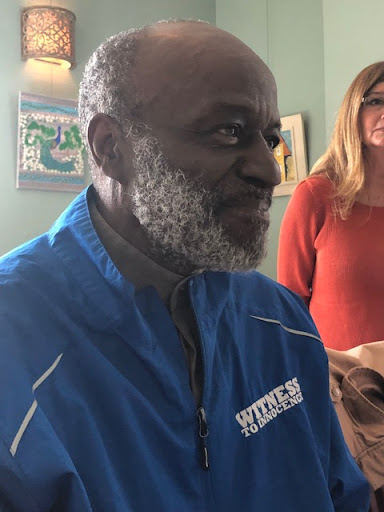
    Shujaa Graham stops short at the sight of the solitary-cell 6’ X 9’ dimensions measured with blue tape on the linoleum floor of the Acme Screening Room lobby in Lambertville, N.J. It’s the afternoon of “Shatter the Silence: Criminal (In)Justice,” a program organized by Indivisible Lambertville/New Hope’s Civil Rights Action Team, where Graham is scheduled to speak.  As attendees file by, many glancing in horror at the cell’s cramped quarters, he steps inside the bounds of a world he knows all too well. Exonerated after five years spent in isolated confinement on San Quentin’s death row, Graham has dedicated himself to Witness to Innocence, a Philadelphia-based organization led primarily by exonorees, seeking an end to the barbarism of the death penalty.

    Out for close to 37 years, Graham stands at the foot of the taped, narrow rectangle labelled “bed,” his eyes far away as he points about, like a tour guide in hell, “It was just like this, only no window, and I don’t remember no desk.  Just half-hour a day to get out for a shower.”

    The United Nations equates more than 15 days in solitary to torture.  But, right here in New Jersey, we rank third in the nation, just behind Nevada and Massachusetts, when it comes to women inmates stuffed in isolated confinement.1 At Edna Mahan, the state’s only prison for women located in Clinton, NJ, the average number of days individuals are so-called “segregated” is 338.

    Any worries the event’s organizers had about turnout on this sunny spring afternoon are dispelled by the over-capacity turnout of 72 folks who showed up to hear Graham and the director of Trenton’s Campaign to End the New Jim Crow (CENJC), Patrick Hall. Patrick’s organization is part of a nationwide movement, inspired by Michelle Alexander’s award-winning book, The New Jim Crow, exposing our racist system of mass incarceration and its destructive impact on minority communities, along with the exploitation of prison labor by many of our country’s biggest businesses, including Walmart, Procter & Gamble, and MacDonald’s, according to Hall.

     “Mass incarceration is about money,” Hall tells the gathering.  “Mass incarceration is an extreme rate of imprisonment. They keep locking people up. Crime is going down.  But, mass incarceration is a business.” Not only are private prisons a big and burgeoning business,2 but their expansion is becoming an economic bedrock of the often poor, white, and rural communities where they are located.3 (Any one listening to National Public Radio during the recent federal government shutdown would have been riveted by the story about unpaid prison guards working in a correctional facility in Oakdale, Louisiana, and what those jobs meant to their community.)

     “Private prisons have contracts, and the cities and counties are getting paid for them too.  They have to keep them filled,” Hall says, matter of fact.

    Although their paths took widely divergent trajectories, both Hall and Graham share a childhood marked by loss and instability.  “Between the first and third grade, I went to 11 different schools,” recalls Patrick, noting that his father was an alcoholic and the family “moved around a lot.” Seeking work, Graham’s parents left their boys with their grandmother when they moved to Los Angeles. Not long after the family was reunited in the depressed South Central neighborhood, Graham, then 12, got caught up in the gang world. “That’s where my troubles begin,” he laments, adding: “They were recycling me in and out of juvenile hall.”

    At 18, he wound up in Soledad State Prison, where his life was forever changed by an encounter with an older inmate who encouraged him to improve his reading skills and learn history “to understand how you got here.”  As Graham recounts: “I started reading right then, and I renounced the gangs. We started organizing.” After moving to another facility in Stockton, Graham got caught up in a prison uprising:

    “On September 27, 1973, a human being was killed. I would have make them kill me that day if I had a clue of what I would face for the next five years.  San Quentin had the gas chamber, and that’s where I went.”

    Framed for his activism, Graham’s first trial ended with a hung jury.  His next two trials were overturned, based on the systematic selection of all white juries. “I never contemplated suicide, but there were nights when I went to bed, it would be OK if I didn’t wake up.” By the fourth trial, Graham was given the chance to help select the jurors, surprising his lawyers by picking a white banker. (“I could tell he was intelligent.”)  He goes on, “The jury deliberated for four days. I was up in a cell, just like the one you see out there. I was pacing.”

    Such a plight is not unlike that of many on Pennsylvania’s death row.  Pennsylvania is the one state in the nation that does not provide funding for the defense of poor defendants, who comprise over 80% of those accused. It cedes this obligation to the counties, leading to a big disparity – in fact, the largest in the U.S. – of capital sentences from county-to-county. The result is a haphazard and inconsistent patchwork of attorney appointment protocols, literally playing Russian Roulette with defendants’ lives.4

    In the Keystone State, some one-third of the convictions on our death row have been overturned as a result of poor lawyering.  Execution of those denied fair and proper representation is tantamount to state-sponsored murder. For this reason, in February, the American Civil Liberties Union and the ACLU of Pennsylvania filed a friend-of-the court brief in February, asking the state Supreme Court to hold PA’s capital punishment system in violation of the PA constitution!

    “I’m tough on crime,” says Graham, by now a grandfather of five. “But, I am against the death penalty.  We don’t need more victims.”

    “I never wanted no one to have to experience what I had experienced,” Graham intones. “Every day, I wake up and think about where I would be if California had its way.”  After offering a standing ovation in tribute, audience members in tears come to hug him, offering their support, some sharing their stories of incarceration.  Graham is crying too, but not for himself. May his tears for those men and women still on death row, may they not be in vain.

    Calls to Action:

    • Curb Solitary in NJ: Tell your New Jersey representatives to support the Isolated Confinement Restriction Act (bills A-314 and S-3261, Assembly and Senate respectively). The bills limit solitary to 15 days at a stretch and ban it for pregnant women, inmates 55 and older, those 21 and younger, as well as folks suffering from mental illness and disabilities. It can only be used on those posing a “serious and immediate risk of harm to self or others” and after all less restrictive measures fail.
    • Stand up for Witness to Innocence: Learn about and support this vital and inspiring exoneree-driven organization: Witnesstoinnocence.org
    • Link arms with our Trenton-based Campaign to End the New Jim Crow: endnewjimcrownj.org
    • Support the PA ACLU: “Defending Liberty Where It Began!”
    • JOIN US! Join the ILNH Civil Rights Action Team as we continue to educate ourselves and our communities about the plight of our nation’s most oppressed populations, promoting sweeping and powerful change for the better.

    Footnotes and sources:

    1. “Reforming Restrictive Housing: The 2018 ASCA-Liman Nationwide Survey of Time-in-Cell”, The Association of State Correctional Administrators, The Liman Center for Public Interest Law at Yale Law School, ASCA-Liman Restrictive Housing 2018 revised September 25 2018, October 2018, pages 14-15.
    2. Michelle Alexander, The New Jim Crow, Mass Incarceration in the Age of Colorblindness (New York: The New Press, 2012), 230.
    3. Ibid., 232.
    4. ACLUPA.Org/News, “ACLU Urges PA”
  • Just the Facts

    Contributed by Olga Vanucci.

    Primary voter turnout in New Jersey in 2017:   15%

    Primary voter turnout in Hunterdon County, NJ, in 2017:   30%

    Primary voter turnout in Pennsylvania in 2017: 16%

    Primary voter turnout in Bucks County, PA, in 2017:   12%

    Sources:  

    https://www.state.nj.us/state/elections/2017-results/2017-official-primary-voter-turnout.pdf

    and

    https://www.philly.com/philly/news/politics/2017-primary-election-roundup-Philadelphia-Pennsylvania.html

    and

    http://www.buckscounty.org/government/CommunityServices/BoardofElections/VoterCounts

  • Civics 101 – The Federal Budget Process – Courtesy of the National Priorities Project

    Contributed by Deb Kline.

    Who Decides the Federal Budget?

    The vision of democracy is that the federal budget – and all activities of the federal government – reflects the values of a majority of Americans. Yet many people feel that the federal budget does not reflect their values and that the budgeting process is too difficult to understand, or that they can’t make a difference.  Many forces shape the federal budget. Some of them are forces written into law – like the president’s role in drafting the budget – while other forces stem from the realities of our political system. And, while the federal budget may not currently reflect the values of a majority of Americans, the ultimate power over the U.S. government lies with the people. We have a right and responsibility to choose our elected officials by voting, and to hold them accountable for representing our priorities. The first step is to understand what’s going on.

    An Evolving Process

    The U.S. Constitution designates the “power of the purse” as a function of Congress.1 That includes the authority to create and collect taxes and to borrow money when needed. The Constitution does not, however, specify how Congress should exercise these powers or how the federal budget process should work. It doesn’t specify a role for the president in managing the nation’s finances, either.

    As a result, the budget process has evolved over time. Over the course of the twentieth century, Congress passed key laws that shaped the budgeting process into what it is today, and formed the federal agencies – including the Office of Management and Budget, the Government Accountability Office, and the Congressional Budget Office – that provide oversight and research crucial to creating the budget.

    Before the Budget

    Congress creates a new budget for our country every year. This annual congressional budget process is also called the appropriations process. Appropriations bills specify how much money will go to different government agencies and programs. In addition to these funding bills, Congress must pass legislation that provides the federal government with the legal authority to actually spend the money.3 These laws are called authorization bills, or authorizations. Authorizations often cover multiple years, so authorizing legislation does not need to pass Congress every year the way appropriations bills do. When a multi-year authorization expires, Congress often passes a reauthorization to continue the programs in question.

    Authorizations also serve another purpose. There are some types of spending that are not subject to the appropriations process. Such spending is called direct or mandatory spending, and authorizations provide the legal authority for this mandatory spending.4 Federal spending for Social Security and Medicare benefits is part of mandatory spending, because according to the authorization, the government must by law pay out benefits to all eligible recipients.

    How Does the Federal Government Create a Budget?

    1. The President submits a budget request to Congress – The president sends a budget request to Congress each February for the coming fiscal year, which begins on Oct. 1.
    2. The House and Senate pass budget resolutions – After the president submits his or her budget request, the House Committee on the Budget and the Senate Committee on the Budget each write and vote on their own budget resolutions.
    3. House and Senate Appropriations subcommittees “markup” appropriations bills – The Appropriations Committees in both the House and the Senate are responsible for determining the precise levels of budget authority, or allowed spending, for all discretionary programs.
    4. The House and Senate vote on appropriations bills and reconcile differences – The full House and Senate then debate and vote on appropriations bills from each of the 12 subcommittees.
    5. The President signs each appropriations bill and the budget becomes law – The president must sign each appropriations bill after it has passed Congress for the bill to become law. When the president has signed all 12 appropriations bills, the budget process is complete. Rarely, however, is work finished on all 12 bills by Oct. 1, the start of the new fiscal year.

    This chart shows how all of these pieces fit together to make the annual federal budget process.

    Continuing Resolutions and Omnibus Bills

    When the budget process is not complete by Oct. 1, Congress may pass a continuing resolution so that agencies continue to receive funding until the full budget is in place. A continuing resolution provides temporary funding for federal agencies until new appropriations bills become law. When Congress does not pass a continuing resolution by October 1, it can result in a government shutdown, such as the longest one in history which was conducted under the Trump administration.

    When Congress can’t agree on 12 separate appropriations bills, it will often resort to an omnibus bill – a single funding bill that encompasses all 12 funding areas. The fiscal year 2015 budget was the result of a combined omnibus and continuing resolution enacted by Congress in December of 2014.

    Supplemental Appropriations

    From time to time the government has to respond to unanticipated situations for which there is no funding, such as natural disasters. In these cases the government has to allocate additional resources and do so in a timely manner. This type of funding is allocated through legislation known as supplemental appropriations.

    It’s Even Messier than It Sounds

    So that’s how the budgeting process is supposed to go. And while that sounds pretty complicated, in practice, it’s even more so. Other factors that include the state of the economy, party politics, differing economic philosophies, and the impact of lobbying and campaign contributions also have a considerable impact on the federal budget process.

    About the National Priorities Project: National Priorities Project is the only nonprofit, non-partisan federal budget research organization in the nation with the mission to make the federal budget accessible to the American public. The organization works to inspire individuals and movements to take action so federal resources prioritize peace, shared prosperity, and economic security for all. In 2014, NPP was nominated for the Nobel Peace Prize in recognition of our pioneering work to track federal spending on the military and promote a U.S. federal budget that represents Americans’ priorities, including funding for people’s issues such as inequality, unemployment, education, health and the need to build a green economy.