INDIVISIBLE Lambertville NJ / New Hope PA

Author: Indivisible Lambertville / New Hope

  • No Peace, No Freedom for Immigrants, Refugees and Asylum Seekers

    No Peace, No Freedom for Immigrants, Refugees and Asylum Seekers


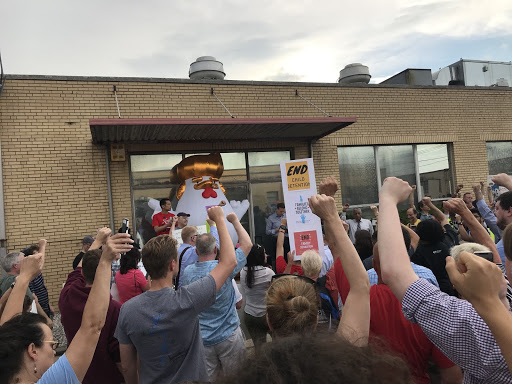
    Several ILNH activists participated in protests against the treatment of immigrants, asylum seekers and refugees in both New Jersey and Pennsylvania. In the photos, Indivizzies Susan Shapiro and Terry Rice stand with other protesters at the Elizabeth (NJ) Detention Center. 


    Headline News: Man and Daughter Drown in the Rio Grande Trying to Reach America 

    Red, White and BlueJohn Smith

    • In the photograph she wears red pants; 
    • her father, blue shorts. Their skin’s white 
    • but not as white as the white on our flag.
    • She is snuggled tight under the back 
    • of Daddy’s black T-shirt as if in a sling-pouch,
    • one arm slung around his neck, 
    • her stubby fingers tangled in the wet weeds 
    • of his hair, both of them afloat face down 
    • in muddy water, their limp bodies run aground 
    • too late. Either she held on even after 
    • he thrashed, spasmed, bucked like a terrified bull, 
    • then went slack; or she would not let go
    • while he slapped water, one exhausted arm 
    • after the other, the distant shore 
    • inching closer. She held tight and squirmed,
    • kicked, cried out for her mother then stopped 
    • and sagged heavy as a backpack full of stone. 
    • What if he had to bear her dead weight 
    • until his lungs burst into flames, 
    • and he breathed the river in 
    • to stop the burning, then sank? 
    • Who can imagine such suffering,
    • such desperation that risking 
    • the Rio Grande was the best option 
    • to begin with? I heard someone say, 
    • At least she won’t be separated 
    • from her father and caged 
    • in a concentration camp.
    • Is that what’s left of mercy 
    • in this country? Is our compassion 
    • so limited that callous sarcasm 
    • is all we have to offer? Do we just sigh
    • and rant online for a couple days 
    • then forget about a daughter’s arm 
    • wrapped around her father’s neck,
    • hanging on to the only hope she knew
    • drowning in the dream of America? 

    John Smith has published poetry in numerous literary journals. His book, Even That Indigo, is available on Amazon. John lives in Frenchtown, NJ with the henna artist/calligrapher, Catherine Lent.

  • Changing the Conversation Together: Join Us in Taking a New Approach to Canvassing

    Contributed by Cindi Sternfeld 

    Have you ever wondered if what we’ve been doing can make a difference? ILNH is constantly looking for ways to save democracy from the attacks we witness on a daily basis. You might ask: can ILNH really save democracy? 

    The answer is, maybe. 

    Maybe we can, if we find new and different ways to engage the electorate. Maybe we can, if we figure out how to bring back the checks and balances that were put in place to keep government of and for the people.  

    Over the past two-plus years, ILNH introduced many campaigns to educate, advocate and activate more citizens to get out and vote. For the most part, our initiatives fall into two categories: LEARN and DO – with a little fun thrown in for good measure. Sometimes the initiatives come from inside the group, and sometimes they come from people we’ve never met or heard of, but who have heard of ILNH.  

    A couple of months back, ILNH was contacted by Adam Barbanel-Fried, who leads Changing the Conversation Together (CTC). CTC is a group of concerned citizens that use a strategy of “deep canvassing,” which teaches volunteers to use their personal stories, empathetic listening and engaged conversations to help voters think about how their values connect with the issues of the day. CTC has used this strategy before and it worked!  

    Adam came to town to explain CTC and to invite us to become partners. He also met with several leaders of other Pennsylvania groups. CTC sees the Pennsylvania 1st Congressional District as flippable, and frankly, so do we.  We want to find out if we can use CTC strategies to flip PA-01. It worked in New York when they used deep canvassing to help Max Rose get elected to NY 11th Congressional district, and we believe it can work here. 

    Adam and the leadership team of ILNH explored several options to make this goal a reality.  Some of the options were large-scale and some were more cautious. After much consideration, it seems that the approach that makes the most sense is to do what we’ve done all along: LEARN and DO. 

    Our plan is to start out by training a core group of volunteers to LEARN deep canvassing, and in the very same day, send them out to DO some deep canvassing.  We are looking at dates in September to pilot the program because the clock is ticking on the 2020 election. 

    We will work with volunteers, partners and other stakeholders to co-host a CTC LEARN and DO event. We’ll gather 30-50 folks to take the next step on the road to success. It will be a full-day event that will teach you how to have conversations about values and then get you and a partner out and knocking on doors.  

    The main difference this time is that you won’t be “selling” a candidate, you will be looking to have conversations with voters about what you, and they, care about.  While our goal is to try to get a deep canvass launched once a month, for now, we want to do a pilot training and see what we can learn. 

    CALL TO ACTION!!

    Today I am reaching out to find volunteers. The coalition of ILNH and other groups is looking to create a mighty band of volunteers trained in the CTC deep-canvassing approach. The rules will be the same as they’ve been all along:  We will NEVER send you out alone; you will have scripts and all of the information you need to be a confident canvasser, and we will work with you to help you have a great experience.  

    If you want to join me in being a part of this exciting change, please sign up at this link to join our team! 

  • Some Good News (Finally) on the Census

    Some Good News (Finally) on the Census

    Contributed by Elaine Clisham

    So, the citizenship question will not appear on the 2020 census form. That’s good news! (But don’t sleep on this — there is already a push to get it included on the 2030 form!) Amid all the flurry over the question in the past few weeks, it was easy to miss some positive census developments here in New Jersey.

    The 2020 census presents unique challenges. It will be the first census to be conducted primarily online, requiring a host of new technologies to be developed and tested. There were originally supposed to be three end-to-end field tests, but budget restrictions forced that number to be reduced to one, meaning the system will not be field-tested again after any identified bugs are fixed. The threat of the citizenship question being added has eroded trust in the census and threatens a robust response, particularly among groups hardest to count. (Hard-to-count communities include communities with a traditionally lower-than target response rate, which in New Jersey is 73 percent; minority communities and communities whose first language is not English; and children under 5 years old. This year, because the census will be conducted online, another hard-to-count category has been added — older residents who are uncomfortable or unfamiliar with the technology they will be asked to use.) And, while there have been increases to the federal budget for the census, there is widespread fear that the budget for partnerships and outreach will not get sufficient funding. None of this bodes well for an accurate census.

    The good news is, New Jersey is taking several steps to try to minimize the risk of an incomplete count.

    First, last fall the state appointed a Complete Count Commission, chaired by Secretary of State Tahesha Way, and charged it with identifying steps New Jersey and local municipalities and community groups need to take in order to ensure that every resident is counted. (You can read more about the commission here; Legislative District 15 Assemblywoman Verlina Reynolds-Jackson, who represents Lambertville, is a member.)

    In June, after a series of public hearings around the state, the commission released its report (available here as a PDF). The report noted the three key advisory committees set up within the commission, and including representatives of hard-to-count communities, that will focus on community advocacy, partnerships with private entities, and education and intergovernmental coordination. It highlighted more than 500 hard-to-count census tracts in all but three counties, where it urged that extra effort — formation of local partnerships and Complete Count Committees, augmented outreach, including in languages other than English — be focused in order to ensure an accurate count. And it detailed plans for establishing a multi-lingual branding and communications campaign to support census outreach efforts throughout the state. These are all critical steps. (A good summary of the commission’s report can be found here.)

    Second, the June meeting of the New Jersey Council of Grantmakers was focused entirely on ways the philanthropic sector can support efforts to secure a complete count. The council is developing partnerships with, and training resources for, its members, and has an entire section on its website devoted to its census efforts. (A good writeup of the council’s meeting is here.) This philanthropic support will be key to successful partnerships and outreach in hard-to-count communities.

    And third, while the budget that Gov. Murphy originally proposed had only $2 million allocated for census outreach, the final version, drafted by the Legislature and now signed by the governor, includes the full $9 million that advocacy groups had requested. So while federal outreach funds may be lacking, New Jersey has now made a pledge to fill the gap.

    All of this means that census prospects in New Jersey look a little brighter than at the federal level. However, we need to take advantage of these resources and work proactively to help ensure a complete count. 

    Call to Action! 

    If you have connections in a hard-to-count community and you want to help, contact any of the members of the state Complete Count Commission about setting up a local Complete Count Committee in that community, and becoming a census outreach partner. Let’s make sure all of New Jersey counts!

  • Are You The One?

    Contributed by Amara Willey.

    What do we make of 5 million Democratic candidates running for president? How does one stand out?

    It’s not a new thing that many people put themselves forward to be the Democratic candidate for President. In the 2016 election, four candidates dropped out before the primaries began, leaving eight candidates to run for the Democratic nomination. In 2008, two candidates withdrew before the primaries, leaving eight candidates still running, including President Barack Obama.  

    With 21 confirmed Democratic candidates for the 2020 race, we can expect some will drop out before the primary, but there are still more than we may know what to do with. How do we start to narrow the field?

    Understandably people are concerned that we need one strong candidate that can defeat the Republican incumbent in 2020. So far, none of the candidates has yet pulled into a resounding lead, but it’s still early.

    Voters care about the issues in 2020, but they also care about electability. At the moment most candidates are running on similar platforms — universal healthcare, climate change regulations, reducing inequality, and improving conditions for the middle class.

    For the last four presidential elections, the economy has been the biggest issue for voters, according to Pew Research Center, In 2016, 84% of voters said the economy was a “very important” factor in deciding how to cast their presidential vote. In 2012 and 2008, it was 87%, while it was the top issue of concern for 78% of voters in 2004. At the moment, the economy is doing pretty well under the current administration.

    The good news is that 96% of 1,007 registered voters polled said it is very or somewhat important that a presidential candidate take “aggressive action to slow the effects of climate change,” according to a survey conducted by research firm SSRS for CNN and released this month. This outstripped Medicare for All, stricter gun laws, and free public college tuition as priority concerns. As we know, the current administration has climate change so far off its radar that it was removed from the White House website just after the inauguration.

    However, issues are not the deciding factor in a presidential election. Concerns about electability, especially with so many Democratic hopefuls, are paramount for many voters. Paul Blumenthal cautions in the Huffington Post, “As Democrats eye their 2020 White House candidates, it’s best to recall that the “electability” path is littered with the bodies of losers.” He recalls other elections, particularly the 2004 Democratic presidential primaries, where we had two likeable candidates, Sen. John Kerry of Massachusetts and Sen. John Edwards of North Carolina, neither of whom ultimately became president. And although Hillary Clinton made electability part of her platform in 2016, ultimately she wasn’t, and the dark horse, the unelectable Donald Trump, was.

    In February, opinion writer Jennifer Rubin warned in The Washington Post that “we should be wary about expecting voters to distinguish between candidates they like and ones that are “electable.” Very often, voters become convinced that the persons they like will be liked by others.”

    An encouraging poll conducted in February by Monmouth University indicates that 57% of voters polled say it’s time for a new president. The poll further found that a majority of 56% of Democrats and left-leaning independents prefer someone who would be a strong candidate against Trump even if they disagree with that candidate on most issues.  Just 33% say they would prefer a nominee who they are aligned with on the issues even if that person would have a hard time beating Trump. Democratic women (61%) are more likely than men (45%) to say they would put their policy positions aside in order to get a nominee who could beat Trump, the Monmouth University Polling Institute reported.

    Sources:

    https://thinkprogress.org/climate-change-democrat-voters-2020-election-5cdf0424044e/

    https://www.huffpost.com/entry/2020-democrats-electability_n_5ccb4a10e4b0d123955076ad

    https://www.washingtonpost.com/opinions/2019/02/05/heres-thing-about-electability/?noredirect=on&utm_term=.ccaa386fb56c

    https://www.monmouth.edu/polling-institute/reports/MonmouthPoll_US_020419/
  • The Millionaire’s Tax Time Has Come for NJ

    Contributed by Deb Kline.

    Since the April Budget Springboard, ILNH constituents have been subjected to a number of actions that call for supporting the Millionaires Tax. As an organization, ILNH is officially joining the NJ Indivisible Advocacy Coalition in supporting passage of the Millionaires Tax, so our numbers add weight as they advocate with NJ legislators.

    So what exactly is it?

    Governor Murphy has proposed that a 10.75% income tax rate be applied to all annual earnings over $1 Million. Currently, only annual income over $5 million is taxed at this rate, and income between $500,000 and $5 million is taxed at 8.97%.

    While the difference may seem relatively small, it would go a long way to reducing income inequality in the Garden State. The average annual income of NJ’s top 1% is in excess of $1.5 million, whereas the rest of the state is averaging about $65,000 in yearly income.

    Perhaps it’s a bit easier to understand like this: The top one percent of NJ makes 24.3 times more than the bottom 99%. The level of income inequality in NJ ranks at the 9th worst in the nation.

    Many legislators, however, have voiced their opposition to Murphy’s Millionaires tax proposal. The arguments are more based in myth than fact. Chief among the misconceptions is the higher tax rate will cause the wealthiest residents to head for more attractive, i.e., lower,  tax environments – aka the “millionaire’s tax flight.” As of this writing, NJ Senate President Steve Sweeney has come out against the Millionaires tax, even though he has supported it in the past.

    New Jersey Policy Perspective, the think tank which independently analyzes state spending of taxpayer dollars and the impacts, has repeatedly exposed this myth, along with several other independent organizations ranging from Stanford University, Center on Budget and Policy Priorities and others. The bottom line: Higher tax rates do not cause the wealthy to move.  

    In addition, with the 2017 Federal tax changes, wealthy earners still come out way ahead. The Millionaires tax also is a marginal tax, meaning that the 10.75% doesn’t apply to the total amount earned, only to that which is in excess of $1 Million.

    The Millionaires tax is highly popular – up to 75% of New Jerseyans support it. The NJ Legislature passed a similar tax five times, only to have it vetoed under former Governor Christie.

    In a nutshell: We need the millionaires’ tax

    • Governor Murphy has promised that the Millionaires tax will go to helping keep property taxes in check. Income taxes in New Jersey must go to property tax relief, so generating more income via a tax on the top earners will mean more property tax relief for all.
    • It will help reduce the effects of extreme income inequality. Right now the top 1% of earners in New Jersey take home 19.1% of all income in the state. In the late 1970s it was closer to 10% of all income.
    • It will not drive high earners out of the state. In 1994, New Jersey had 10,481 tax filers, or 0.2% of all filers, who reported income of $500,000 or more; in 2015, the state had 62,154 such filers, or more than 2% of all filers.

    Call to Action:

    • Call or write your state legislators — if you don’t know who they are, you can find out here — and tell them you support the Millionaires’ tax and you want them to make sure it stays in the budget. Every call makes a difference. They need to hear from their constituents that they should do the right thing, especially this year since the Assembly is all up for re-election in November.
    • Call or write Senate President Steve Sweeney and tell him to support the Millionaires tax. He did so previously but has come out against it this round.
    • Thank Senator Shirley Turner for coming out in support of the Millionaires tax at a town hall on 5/6/19.
    • Ask your legislators to make a public statement in support of the Millionaires’ tax. This can help sway legislators who are undecided.
    • Attend: The Tax Fairness and Advocacy Training hosted by NJPP on May 19 at Rutgers. Pre-registration is required: https://www.facebook.com/events/694134897667403/

    If you live outside of NJ, find out if there are similar existing taxes or proposals in your state. If not, call on your legislators and tell them there’s every good reason to get it on the docket and no good reason not to.

    Source: Millionaires Tax is the Right Policy at the Right Time, Brandon McKoy, president, NJPP, April 2, 2019