INDIVISIBLE Lambertville NJ / New Hope PA

Author: Indivisible Lambertville / New Hope

  • The Battle to Save Health Insurance is Making Me Sick

     Contributed by Caroline Armstrong.

    It’s true. I wake up each morning with a belly ache, wondering how much longer I will be able to hold onto my health insurance. For more than two years, we have been fighting to preserve and to shore up the Affordable Care Act (ACA) in the face of a relentless effort by the Trump administration and the GOP to dismantle the ACA, including an ongoing federal court battle to overturn it. 

    There appears to be no end in sight. Quoting Senator Lindsey Graham: “If we can get the House back and keep our majority in the Senate, and President Trump wins reelection, I can promise you not only are we going to repeal Obamacare, we’re going to do it in a smart way where South Carolina will be the biggest winner.”

    True, the 2020 Democratic Presidential candidates have made healthcare a premier campaign issue, with many going on record supporting various versions of universal healthcare or at least vastly expanded coverage. But, that’s a longer term vision. What I worry about is what’s right in front of us here and now. That’s why I believe we all need to turn to our State representatives to ensure that we are adequately protected in the event the ACA goes down. 

    I applaud Pennsylvania and New Jersey for enacting some critical pieces of health care legislation over the past year or that counteract federal efforts to undermine the ACA. This summer, Pennsylvania passed legislation to create a state-based ACA health insurance marketplace and authorized the creation of a new reinsurance program, both aimed at lowering insurance premiums and increasing access to health insurance. New Jersey enacted similar legislation along with several other important pieces of legislation, including one enabling the state to create its own individual mandate, an ACA provision that stopped being enforced as a result of the GOP 2017 tax law. 

    We still need more. Protecting coverage for pre-existing conditions, preserving the essential health benefits under the ACA, ensuring those up to the age of 26 continue to be eligible for coverage under their parents’ insurance are examples of outstanding needs that we must make sure are met through additional state legislation.

    Be informed, learn more at the October Springboard: 

    Get the latest on the health insurance front at the state and national levels at the upcoming Indivisible Lambertville/New Hope Springboard program called “Health Insurance – Are We at Risk of Losing It?” on Monday, October 7, 7:00-8:30 pm at the Phillip L. Pittore Justice Center, 25 S. Union Street, Lambertville, NJ. The program will feature three policy experts in the healthcare field who will tell us the latest and entertain your questions, and include a discussion of actions we can take as concerned citizens. Sign up now at the Indivisible Lambertville/New Hope website.

    ______________________

    1 August 5, 2019 interview on “The Morning Answer with Joey Hudson”
  • Just the Facts on Healthcare

    Contributed by Olga Vanucci.

    • In 2017, 8.8% of people, or 28.5 million people, did not have health insurance at any 
    • point during the year.  
    • In 2017, employer-based insurance covered just 56% of the population, followed by Medicaid (19%), Medicare (17%), direct-purchase coverage (16%), and military coverage (5%).
    • Between 2016 and 2017, the percentage of people without health insurance coverage decreased in 3 states and increased in 14 states.
    • About 43 million Americans have unpaid medical debt.  This includes people who have insurance.
    • About one in six Americans received a surprise out-of-network medical bill in 2017 after being treated in a hospital, even though they had insurance.
    • The top 25 countries with the best healthcare systems have this in common:  they all provide universal healthcare. The U.S. is not in the top 25.

    Sources:

    https://www.census.gov/library/publications/2018/demo/p60-264.html

    https://www.theatlantic.com/health/archive/2019/08/medical-bill-debt-collection/596914/

    https://ceoworld.biz/2018/02/14/the-top-25-countries-with-the-best-healthcare-systems-the-world-in-2017/

  • School Choice Gets Fake Boost after EdNext Poll

     Contributed by Amara Willey.

    U.S. Secretary of Education Betsy DeVos has been crowing about her Education Freedom Scholarships after the release of the latest Education Next poll. Announced on Aug. 20, the poll results indicate widespread support for charter schools. DeVos is using these results to justify the school choice scholarships hatched by her department.

    More than 60 percent of Republicans support charter schools while just 27 percent oppose them. For Democrats, 40 percent support charter schools, with 47 percent of Hispanic Democrats, 55 percent of African American Democrats, and 33 percent of white Democrats favoring them. 

    According to the National Alliance of Charter Schools, these results are misleading because charter schools are public schools – they cannot charge tuition or hold religious activities. The Education Freedom Scholarships are not supportive of charter schools, but rather of private schools and other alternative school choices, which did not change substantially in the poll. Among Democrats, support for universal vouchers has risen only 3% since last year.

    While not mandatory for states to participate in the program, Education Freedom Scholarships are privately funded by businesses and individuals in exchange for a tax credit and can be used for diverse K-12 educational purposes, which will be determined at the state level. Some of the ways it could be used include concurrent and dual enrollment, career and technical education, tutoring, certifications, and private school tuition. 

    The good news in the face of DeVos’ fake news about the poll is its mandate for “free college” and higher teacher pay. The bad news is how support for school choice in the Democratic party follows a racial divide. African-American Democrats support targeted school vouchers, universal vouchers, and charter schools at 70%, 64%, and 55%, respectively. Among Hispanic Democrats, support for the three policies is at 67%, 60%, and 47%. On the other hand, just 40% of non-Hispanic white Democrats support targeted vouchers, 46% support universal vouchers, and 33% support charter schools, as reported by GlobeNewswire.

    The argument in favor of school vouchers for low income students concerns the quality of education available to them in the public schools. Many families believe their children will receive a better and safer education at a private school using a school voucher, which is partially why this argument is drawn along racial lines. However, as funds are diverted from public schools, it will be more difficult to increase the quality of education there, starting a downward spiral.

    Interestingly, the poll finds that more Americans have a positive view of public schools now than they did anytime after 2007, which will help public schools keep students and therefore tax dollars. 

    DeVos has claimed that no federal dollars are going into these scholarships, which is technically true, as they will be funded by private individuals and businesses. Nevertheless, the Freedom Scholarship program will cost taxpayers an estimated $5 billion in lost revenue due to the tax incentives.                                                 

    Sources:

    https://www.educationnext.org/school-choice-trump-era-results-2019-education-next-poll/

    https://www.ed.gov/news/press-releases/us-secretary-education-betsy-devos-reacts-2019-education-next-poll-%E2%80%9Cclearly-our-education-freedom-scholarships-proposal-solution-american-families-want%E2%80%9D

    https://finance.yahoo.com/news/2019-education-next-poll-democrats-100000266.html

    https://www.federationforchildren.org/education-freedom-scholarships-3-things-you-need-to-know/

    https://www.washingtonpost.com/politics/2019/04/08/betsy-devoss-claim-about-public-funding-education-freedom-scholarships/?noredirect=on

  • Say This, Not That

    Contributed by Liza Watson.

    The Trump administration has proposed a 12% reduction in education spending for 2020, marking the third straight year it has looked for deep cuts to education. Early childhood education programs are often on the chopping block, yet its been repeatedly shown that such programs pay a better dividend than investing in the stock market.  In NJ, however, Governor Murphy expanded the state’s funding of early childhood education by another 28 programs. With a new school year is starting, here are some ideas for discussing the benefits of early childhood education: 

    Say this:  Before kindergarten, a child’s brain architecture undergoes intense development, so early childhood programs help to lay critical foundations.

    Not this:  As long as kids are kept safe in daycare, learning and development take care of themselves.

    Say this:  Early childhood education is like a plugging station that parents can use to power up children’s learning opportunities.

    Not this:  Children learn by passively absorbing from their families.

    Say this:  Children benefit from remodeling our education system to build opportunities for the future.

    Not this:  The only answer is to hire more teachers and hold them accountable.

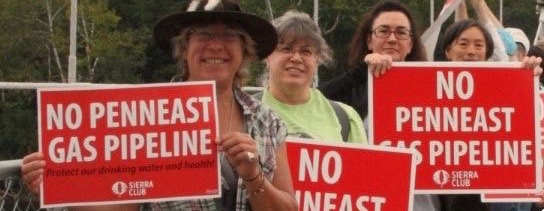
  • PennEast Pipeline Action Alert!

    PennEast Pipeline Action Alert!

    Contributed by Liz Peer, Environmental Action Group

    Comment now on PennEast’s new application to the state of New Jersey here. Comment period is 60 days from August 20, so don’t wait. Some talking points to help you are below: 

    • NJDEP has sufficient information to determine that this pipeline can’t be constructed in a manner that meets the stringent environmental standards required under state law and regulations. NJDEP should deny the permits with prejudice.  This point should be included in all communications!
    • Extensive wildlife surveys conducted by independent biologists documented the significant occurrence of long-tailed salamanders and other sensitive species throughout the proposed route. These reports were submitted to the State Natural Heritage Database.  NJDEP should rely on these data, which show that PennEast would threaten protected species of wildlife, rather than PennEast’s incomplete surveys, in order to ascertain the true impact the pipeline would have.
    • PennEast would cut through Baldpate Mountain in Mercer County, an important bird area supporting numerous migrating and breeding species, including 28 ranked by the American Bird Conservancy as birds of conservation concern. PennEast would cross or come within 100 feet of four important bird areas, posing a threat to irreplaceable wildlife.
    • Research has found that open-cut, isolated, and Horizontal Directional Drilling (HDD) stream-crossing methods for pipeline construction have damaged channel morphology, water quality, and aquatic life, and habitats.  Any of these stream crossing methods will result in unacceptable impacts to protected waterways and wildlife.
    • According to industry sources, Horizontal Directional Drilling crossings (HDDs) cause inadvertent returns or frack outs 50% of the time. It is a coin toss whether an HDD will fail or not. The Mariner East 2 project in Pennsylvania clearly demonstrates the extensive environmental damage these inadvertent returns can cause to wells and waterways. As of February 2019, there were about 240 inadvertent returns of drilling fluid to land and water along the Mariner East 2 route, and the Pennsylvania Department of Environmental Protection had issued 94 notices of permit violations.  
    • By adding impervious surface to local watersheds, construction of the PennEast pipeline would exacerbate sediment-loading in the D&R Canal – threatening a drinking water source for millions of central New Jersey residents.
    • Researchers have identified the potential for arsenic contamination in some areas along the PennEast pipeline route. The geology in areas along this route includes rock that is rich in arsenic, and disturbance of these areas could release arsenic into groundwater in an area of the state that already has high levels of arsenic in groundwater.
    • Nearly 800 drinking water wells in NJ and PA are within 800 feet of the proposed pipeline route and are at risk. Given that numerous wells were contaminated as a result of HDD inadvertent returns from Mariner East 2 construction, there is no reason to believe PennEast would produce a different result.
    • Construction of PennEast poses a significant risk to the Swan Creek Dam, which if ruptured, would result in catastrophic flooding in Lambertville.
    • PennEast would cut through over 4,300 acres of land preserved by the state, counties, municipalities, and non-profit organizations. Taxpayer dollars have been invested in these lands to protect water, natural, historic, and agricultural resources for the benefit of the residents of New Jersey. NJDEP should not allow a pipeline that would threaten this investment.  
    • A study by the Goodman Group found that PennEast overestimated by two thirds the number of jobs that would result from construction of the pipeline, and that only 10 ongoing jobs would be created in New Jersey. According to The Cadmus Group report, all forms of renewable energy – such as wind and solar – or energy conservation projects would be expected to create more jobs than PennEast – from 2,744 to 13,719 additional jobs for the same level of investment.
    • The NJ Rate Counsel found no public need for PennEast, called it “unfair to ratepayers” and concluded that the project is driven by PennEast’s opportunity to earn a 14% rate of return that would be like “winning the lottery” for the project sponsors.