INDIVISIBLE Lambertville NJ / New Hope PA

Author: Indivisible Lambertville / New Hope

  • Talking about climate change

    Contributed by Liza Watson.

    Two ILNH members attended a Stanford political psychology professor’s talk on the effects of persuasive messages on attitudes toward climate change. He has been studying this area for a long time – bottom line is that attitudes are very hard to affect, and about 80% of the adult population has the view that humans have played a role in causing climate change. If you run into a climate change denier, here are some tips:

    Say this: If you asked a room of 10 Americans about global warming, eight would say they accept the knowledge that it is happening.

    Not this: You just have to “believe” in climate change.

    Say this: Most of your neighbors and community members have the view that our planet is warming and that we humans have played a role in this change.

    Not this: Be a rebel, say you accept scientific evidence.

    Say this: I’m happy to learn that 74% of Americans prefer preparation for changes that will come with our changing climate instead of waiting to see what we have to deal with.

    Not this: Some people are ostriches – they are going to see their beach homes destroyed and they won’t get their head out of the sand.

  • You! Guilty as Charged! The Thing is…You’re Innocent.  

    Contributed by Shara Durkee, Cynthia Jahn and Deb Kline.

    Sign up NOW! Springboard Meeting on Mass Incarceration and Criminal Justice Reform – Sunday, April 7, 2019

    Imagine you’re on death row for a crime you never committed. That is the plight once faced by those who have been exonerated and now speak out through Witness to Innocence (WTI). WTI is the nation’s only organization dedicated to helping end the death penalty by giving voice to death row survivors.  

    WTI presenter, Shujaa Graham, knows the experience all too well. Graham was exonerated from San Quentin’s death row in 1979 and finally released in 1981. Graham will be joined by Patrick Hall, co-chair of the Princeton/Trenton Chapter of the Campaign to End the New Jim Crow (CENJC). Patrick is an advocate for an end to the mass incarceration that is decimating whole communities; the banishment of cruel punishments, particularly solitary confinement; and exposure of the ways that big business exploits prison labor.

    The U.S. has the most prisoners per capita of any country in the world. With just 4.4 percent of the global population, the country houses 22 percent of the world’s prisoners, the wide majority of which are African-American. That number is only growing with the advent of harsher sentencing and the rapid expansion of for-profit prisons, which did not exist before Reagan’s “War on Drugs” in the 1980s. In 2016, the Justice Department announced that it would end private prisons, based on issues of safety and effectiveness. But, the Trump administration reversed this plan.

    In New Jersey and Pennsylvania, there are pressing issues that compel greater awareness about the experiences of people accused of crimes, before, during and after adjudication:

    In Pennsylvania, if you’re poor, you’re on your own. Pennsylvania is the only state in the  nation that fails to provide funding for poor defendants, who comprise over 80% of those accused of crimes in the Commonwealth. For prisoners on death row, lack of an adequate defense has led to reversals of one-third of the convictions. In February, the American Civil Liberties Union (ACLU) and the ACLU of Pennsylvania filed a friend-of-the court brief, asking the state Supreme Court to hold the state’s capital punishment system in violation of the Pennsylvania constitution.

    In NJ, cruel, long-term solitary confinement may be outlawed. The statehouse is considering legislation to end the torturous conditions that pen some 1,500 inmates in isolated, windowless cells for years and even decades. The current aim is to limit this extremely punitive treatment to 15 days and to bar its use on young and older inmates, as well as pregnant women.

    The two-hour session will include time for Q&A with the speakers, call to action takeaways, and multiple ways to get involved.

    Registration for the event: ilnhclone.indivisible.blue

    Location: Phillip L. Pittore Justice Center, 25 S. Union Street, Lambertville, NJ

    Date/Time: Sunday, April 7, 2019  2:00 to 4:00 pm.

  • SPRINGBOARD to Immigration Advocacy and Reform

    Contributed by Deb Kline.

    Review and Action from ILNH’s First Springboard Meeting

    The first-ever ILNH Springboard Meeting hosted Johanna Calle, director of the NJ Alliance for Immigrant Justice (NJAIJ), who spoke to a crowd of 20 Indivizzies and friends about the issues facing immigrants on the federal and state level.  The Alliance is a statewide coalition of more than 40 faith, labor and community organizations that promote policies in NJ to advocate for and support documented immigrants and those seeking status.  

    Johanna spoke about the changes in immigration policies over the past 20 years, noting that the window of opportunity for an immigrant to gain residence in the U.S. has increasingly narrowed. Today, an immigrant seeking permanent residence requires that they must be directly related to a U.S. citizen, i.e., spouse or child. She also explained that many ‘unlawful’ immigrants are those that have overstayed a travel visa or had an expired Green Card, in which case they are banned from the U.S. for ten years.

    “The reality is, the immigration laws are broken,” said Johanna. Her own family came to the U.S. in 1995, and was able to get Social Security numbers, driver’s licenses, open a business. But that all changed after September 11, 2001, when laws began to tighten following the terrorist attacks.

    The need for wholesale immigration reform is widely recognized across the political spectrum, but broad disagreement on how to go about it has necessitated that advocacy groups focus on smaller pieces of the issue to make headway. In the meantime, organizations like NJAIJ are putting efforts into helping those at risk avoid deportation, and advocating for policies that limit the level of reach of Immigration and Customs Enforcement (ICE) and Customs and Border Patrol (CBP).  

    Currently, NJAIJ has two focus areas: In addition to family unity and protection from deportation, the organization is advocating for the expansion of driver’s licenses to immigrants seeking status. With the campaign, “Let’s Drive NJ,” the organization works to bring NJ in alignment with the other twelve states which allow undocumented immigrants obtain licenses. Doing so will help increase public safety, help the state’s economy and increase the well-being of families. A note here that although the NJAIJ is a NJ-based organization, Pennsylvania has a similar program working to expand access to driver’s licenses.

    The Springboard meeting on March highlighted the many actions Indivisible members can advocate for on the state and local levels of government. This is very good news.  Possible activities of our group include monthly postcard parties, urgent PRN post card parties, organize trips to the Elizabeth Detention Center, monthly calls to state/local officials, etc. In addition, we will be maintaining ongoing contact with Johanna, to stay updated and send out alerts to Indivisible when there is an action that needs to be taken.

    On the schedule: A follow up meeting of the NJ Immigration Advocacy team to organize actions will be on April 4 at 7:30 p.m. at the Lambertville Free Public Library.

    Eye Openers:

    • ICE has funding to detain 40,000 people; however, it currently holds 50,000. There is a huge funding gap that needs to be made up.
    • NJ has the third largest number of immigrants in the country and the fifth largest number of undocumented immigrants.
    • Detention pays: In NJ, counties and corporations are paid $170 per day for each person who is housed in a detention center.
    • NJ counties Essex, Hudson and Bergen, are currently receiving funds for detention housing that go directly into the county budget.
    • Witnesses and victims of crimes who fear their personal detention or deportation avoid reporting incidents to law enforcement as ICE patrols the courts and works with local police and organizations.
    • Language is important: Use “fair and welcoming” instead of “sanctuary.” The latter implies that immigrants are safe and that the municipality may be breaking the law.
    • “Affiliation” with a gang is a factor leading to deportation; however, young people have been picked up simply for wearing a personal item of clothing that happens to be one of the colors of a gang.  
    • Undocumented immigrants pay taxes and Social Security, but are blocked from receiving any of the benefits.
    • At the federal level, NO new laws have been passed with regard to immigration policy and access to citizenship. All changes have been made at the administrative, Department of Homeland Security level.

    Noteworthy:

    • In NJ, new rules went into effect on March 15, implemented by the NJ Attorney General, called the “Immigrant Trust Directive.” This trust outlines when the state’s 36,000 police officers can ask people about their immigration status and cuts back on cases where police can cooperate with federal Immigration agents. The rules also limit when county jails can detain prisoners who are in the country illegally.
    • In the U.S. Congress, HR 6 was introduced in the House the week of March 11, and deals with Dreamers and those with Temporary Protected Status. Representatives Tom Malinowski and Bonnie Watson-Coleman are co-sponsors.  

    In Pennsylvania – organizations that provide support and advocacy for immigrants include:

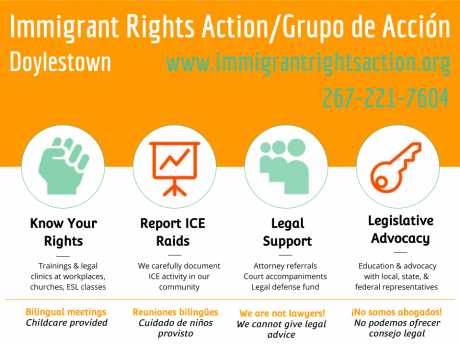
    Immigrant Rights Action/Grupo de Acción of Doylestown is a way to get involved with local actions. The group has developed packets to enable constituents to talk to their legislators, and works in conjunction with other groups to provide local trainings for allies and immigrants. The organization recently incorporated and has established office space to meet with community members. Group meetings on the first Wednesday of the month. Reach out to Sue Ann DeVito if you would like to join.

    MILPA spearheads the legislation for Pennsylvania drivers licenses. When the legislation is introduced, we will need to call state legislators for support.  Chris Rabb, State Representative (200th HD) , is working on introducing a bill.

    Shut Down Berks is a coalition working on shutting down the Berks Detention Center. They organize vigils, rallies, postcard parties and legislative advocacy. Follow their page on Facebook to see upcoming calls to action.

    PICC (Pennsylvania Immigration and Citizenship Coalition) has many resources to help the community on their website. The activist tab has a plethora of information, and areas you can take action. Recommended: sign up for their STOP THE HATE CALLS.

    Welcoming The Stranger is in Bucks County and has free classes and resources for immigrants and refugees.

  • Immigration True or False?

    Immigration True or False?

    Courtesy of the Immigrant Rights Action Group of Doylestown.

    Propaganda is a powerful tool. Truth is a powerful antidote.

    The current administration has created a false narrative around the story of immigration as a way of dividing and isolating people from one another, and of making us afraid. Stoking fear is a strategy to gain control. People who are afraid are more apt to compromise on things they believe in.

    You can help to counter the dangerous, racist narrative around immigration. In an era where traditional sources of information are no longer trusted, you have more power than you know by simply having personal conversations. Speak with someone; a neighbor when cutting the grass, a co-worker at the lunch table, a friend at a party, and counter the narrative.

    Here are the facts:

    Immigrants make our communities less safe: False!

    Undocumented immigrants represent only 3.4% of the total US population. And Immigrants are 25% less likely to commit a crime than native-born Americans. We would be made much safer by focusing our resources on other issues such as gun violence, mental health, or substance abuse prevention.  

    Immigrants are milking the American taxpayer: False!

    The most recent IRS data, from 2015, shows that the agency received 4.4 million income tax returns from workers who don’t have Social Security numbers, which includes a large number of undocumented immigrants. That year, they paid $23.6 billion in income taxes.  They paid billions of dollars for benefits they will never be able to use.

    Immigrants are taking jobs that Americans need: False!

    A recent study estimated the consequences if all undocumented New York agricultural workers are deported: There would be a 24 percent fall in farm production (amounting to $1.37 billion in commodity value lost) and a knock-on effect of nearly 45,000 lost jobs across the state. In 2017. Fortune Magazine reported that in two California counties alone, 13 million in crops were left unpicked, and predicted higher prices for produce.

    Immigrants are flooding the southern border: False!

    According to data from the Department of Homeland Security, illegal crossings are now at historic lows—about one-fifth of what they were at their peak in the late-1990s and early-2000s.

    Immigrants can just get in line and follow the legal process: False!

    The fact is there are different lines for different people. Certain types of people have to wait decades to apply for an immigrant visa, while others take a much shorter amount of time. A U.S. permanent resident’s unmarried son or daughter, who is 21 years old or older, will have to wait roughly 20 years to file an application for an immigrant visa if they’re from Mexico, according to the State Department’s visa bulletin.

    Criminal groups like the MS-13 are taking advantage of the U.S. asylum or immigration system to place gang leaders in the United States. False!

    Of all unaccompanied minors apprehended at the southwest border since 2011, 0.02 percent were either suspected or confirmed to have ties to gangs in their home country, according to U.S. Border Patrol Acting Chief Carla Provost. That’s 56 minors out of 250,000. The MS-13’s membership makes up less than one percent of all criminally active gang members in the United States and Puerto Rico.

    Learn more about facilitating dialogue at www.better-angels.org

    Support the Immigrant Rights Action Group of Doylestown Legal Defense Fund, which has raised more than $9000 since we formed in 2017. 100 percent of this money has been used to secure ethical immigration attorneys for neighbors, co-workers and community members facing deportation.

  • What Makes Jane or Dick Run — For Office?

    Contributed by Amara Willey & Deb Kline.

    Why would anyone put themselves out there to run for office in today’s political climate? Fortunately, many do as in this most recent election we saw a significant increase in the number of candidates. Still, there are many areas – local politics especially – where there are unopposed seats. Is this your year? Hear from some who have taken the leap.

    Tom Malinowksi, Representative from NJ CD7, U.S. House of Representatives

    What inspired you to run?

    After the election in 2016, I was fired from my job at the State Department by President Trump, which was not the normal way the government transitions to a new administration. I knew first and foremost that in my next job I wanted to be in a position where I could fight back against the injustices I saw happening in our government.  Helping take back the House of Representatives was the greatest impact I could have made at the time, and my district happened to be one of the most flippable in the country. After thinking about everything we could achieve with a House under democratic control- the Gateway Tunnel, universal background checks, getting the SALT deduction back, affordable healthcare- it was an easy decision after that.

    What are three key things you learned?

    I learned a lot over the last two years, but the most important thing was the power of grassroots organizing, and that includes groups like Indivisible. On the campaign we built up an amazing network of volunteers across the district, and I could not have won without them. We had a lot of big rallies with hundreds of people attending, and it was fantastic to see that enthusiasm, but it was really those first few events that taught me the power of democracy. I was speaking with small groups in supporter’s living rooms trying to win over one vote at a time. I had never run for office before, and those experiences taught me how to be a candidate, and really listen to the issues that my constituents care about.

    What advice do you have for anyone who is thinking about running?

    I say do it! This past election season we saw an unprecedented number of women and minorities running for office which is amazing. We need voices from every background representing us not just in Congress, but every level of government. It is not a decision to make lightly, but it’s always worthwhile to try and better the community you live in.

    Would you do it again?

    Absolutely. Running for Congress was an amazing experience and representing New Jersey’s 7 district is one of the greatest honors of my life. Growing up an immigrant kid from Poland I was so proud to call New Jersey home, and living here gave my mother and I opportunities we never would have gotten in Poland. Every day I get to give back to my state and fight to make this country better, and there isn’t much more I could ask for out of a job.

    Helen Tai – Former Representative, Pennsylvania State General Assembly

    When she ran for Solebury Supervisor, Helen Tai felt that she owed it to the community. As the board of Supervisors changed during the six years she was involved with it, from being entirely Republican to entirely Democratic, Helen found satisfaction from being able to get things done in the town she loves. She was surprised at how much money it took to run for the Pennsylvania state legislature ($500K for the special election; $600K for the regular election), and once she won the special election, at how difficult it was to learn how to govern while engaging in all the things she needed to do to be reelected, like fundraising and knocking on doors. Her races garnered a lot of support, not just locally but nationally as well. She recalls what it felt like to have members of Indivisible Baltimore drive up to canvass for her, and how getting donations from far-flung locations like California and Hawaii helped energize her campaign. What she didn’t realize was how factors that weren’t straightforward can affect an election, citing how the Congressional race brought out more Republican voters than was expected. She says she wouldn’t run for the state assembly again, preferring to work in the background for now on renewable energy and gun safety issues. She’s also active with the Bucks County Democrats in revamping some of the way the party functions and with training other would-be candidates.

    Rielly Karsh – Councilwoman, Town of Clinton, NJ

    Although she has always been involved in activism, Rielly decided to run when she began listening to herself encourage people to seek office with Action Together New Jersey. She believes that women, and moms especially, have the ability to make positive impact for all walks of life. She learned a lot from the process of her candidacy. She found out that she is good at running – the average candidate runs three times before s/he wins; Rielly won her first election. She also realized that she can help others run and began a business called Moms Running. She counsels, “Don’t let fear get in your way. Don’t think you don’t have enough experience – you learn by doing it.” She also encourages people to know why they are running. “You need a deeper reason than wanting to do good,” she says.

    Stacey Abrams, former Representative, Georgia General Assembly (2007-2017), Democratic candidate, Governor (2018)

    “My reason for running was simple. I love our country and its promise of opportunity for all. And I stand here tonight because I hold fast to my father’s credo. Together, we are coming for America, for a better America.”

    Feb 5, 2019 – Rebuttal to the State of the Union address