INDIVISIBLE Lambertville NJ / New Hope PA

Category: Legislation

  • Action Group Focus: Healthcare — A Right at Risk

    Although the efforts to repeal and replace the Affordable Care Act (ACA) “failed,” it continues to be under daily assault by the Trump administration and the Department of Health and Human Services. The Trump administration has resorted to chipping away at the foundations of the ACA to push it toward its demise – eliminating the individual mandate, allowing health association plans, eliminating or “pausing” important taxes that fund ACA subsidies for low-income Americans, and eliminating the cost-sharing provisions in the individual health marketplace. Moreover, the Trump Administration continues its assault on Medicaid and is encouraging states to apply for waivers that mandate work requirements for “able-bodied” adults within the Medicaid population. The good news is that, thanks to hard work by groups like ILNH and many others in promoting ACA enrollment, the efforts by this administration to thwart Americans from signing up for health insurance on the individual marketplace did not work, and many people signed up for coverage – in fact, the numbers are very close to last year!

    Read more about the chipping away at the ACA, people to follow and resources at the link here and come to the Feb. 11 Community Gathering/General Meeting at DIG Yoga, (address) at 3pm.

    Call to Action: What Can You Do?
    1. Write letters to Congressmen Lance and Fitzpatrick demanding leadership to stabilize the ACA and protect women’s health!
    2. Write state action letters to both New Jersey and Pennsylvania governors, asking them to take actions to stabilize the healthcare market at the state level – establishing an individual mandate within the state and strong regulations to protect the most vulnerable within our communities.

    Additionally, the Trump administration and the GOP have attempted to force the collapse of the ACA and erode women’s health initiatives even further through the following mechanisms:
    • Eliminating the funding for cost-sharing reductions available to low-income Americans who purchased their health insurance on the exchanges;
    • Passing a tax bill that repealed the individual mandate, which destabilizes the risk pool within the exchanges by allowing (even encouraging) young/healthy people to opt out of purchasing health insurance;
    • Attacking Medicaid, Medicare and other social safety net programs, stating that the United States can not “afford” these programs – after passing a tax bill that adds $1.5 trillion in national debt, all just to award the wealthy and corporations a big tax cut;
    • Allowing health association plans, purchasing health insurance across state lines, and extension of short-term coverage plans – all aimed at destabilizing the individual health insurance marketplace;
    • Delaying and/or discouraging bipartisan efforts (e.g., the Alexander-Murray Bill) to improve the ACA;
    • Delaying the reauthorization of the Children’s Health Insurance Program (CHIP) and not reauthorizing community health centers;
    • Continuing efforts to defund Planned Parenthood; allowing the removal of birth control coverage in health insurance plans based on “religious/moral” grounds; signing an executive order that allows health professionals to deny health services on the basis of “religious freedom;” and allowing gender bias in health Association Plans
    Healthcare Facts

    1. What is Medicaid and whom does it cover?
      • Medicaid is the nation’s public health insurance program for low-income people, families and children, pregnant women, the elderly, and people with disabilities, and covers one in five Americans (many with complex and costly needs for medical care and long-term services).
      • Income threshold and other factors that determine Medicaid eligibility vary by state, but low-income eligibility is pegged to the federal poverty level, which is calculated for one person at $12,060 and for a family of four at $24,600. Under the ACA, states have the ability to increase these thresholds to $16,394/$33,534.
      • Approximately 81 million Americans receive Medicaid. Most (67 percent) of the recipients are poor children, elderly, and the disabled. Two-thirds of the adults who receive Medicaid are full-time workers and an additional 13 percent work part-time.
      • 60 percent of Medicaid expenditures cover the disabled and elderly populations – mostly in nursing homes.
    2. How many Planned Parenthood and community health facilities are in our districts?
      • In Leonard Lance’s district, NJCD 7: In Hunterdon County there is one Planned Parenthood office and there are NO community health centers. The Planned Parenthood facility is the only facility in the entire county where low-income residents have access to primary care services. No federal dollars are spent on abortions.
    Resources:
    Follow these Twitter accounts: Sarah Kliff (@sarahkliff); Andy Slavitt (@andyslavitt); Loren Adler (@lorenadler); Stephanie Armour (@stepharmour1); Charles Gaba (@Charles_Gaba); Larry Levitt (@Larry_Levitt); Alex Ruoff (@AlexRuoff); Topher Spiro (@topherspiro); Louise Norris (@LouiseNorris)

    Podcasts: Kaiser Health News’ What the Health; Vox’s The Weeds

    Sign up for Sarah Kliff’s VoxCare newsletter
  • Hot Topic In Our Own Back Yard: FERC Approves PennEast Pipeline

    Hot Topic In Our Own Back Yard: FERC Approves PennEast Pipeline

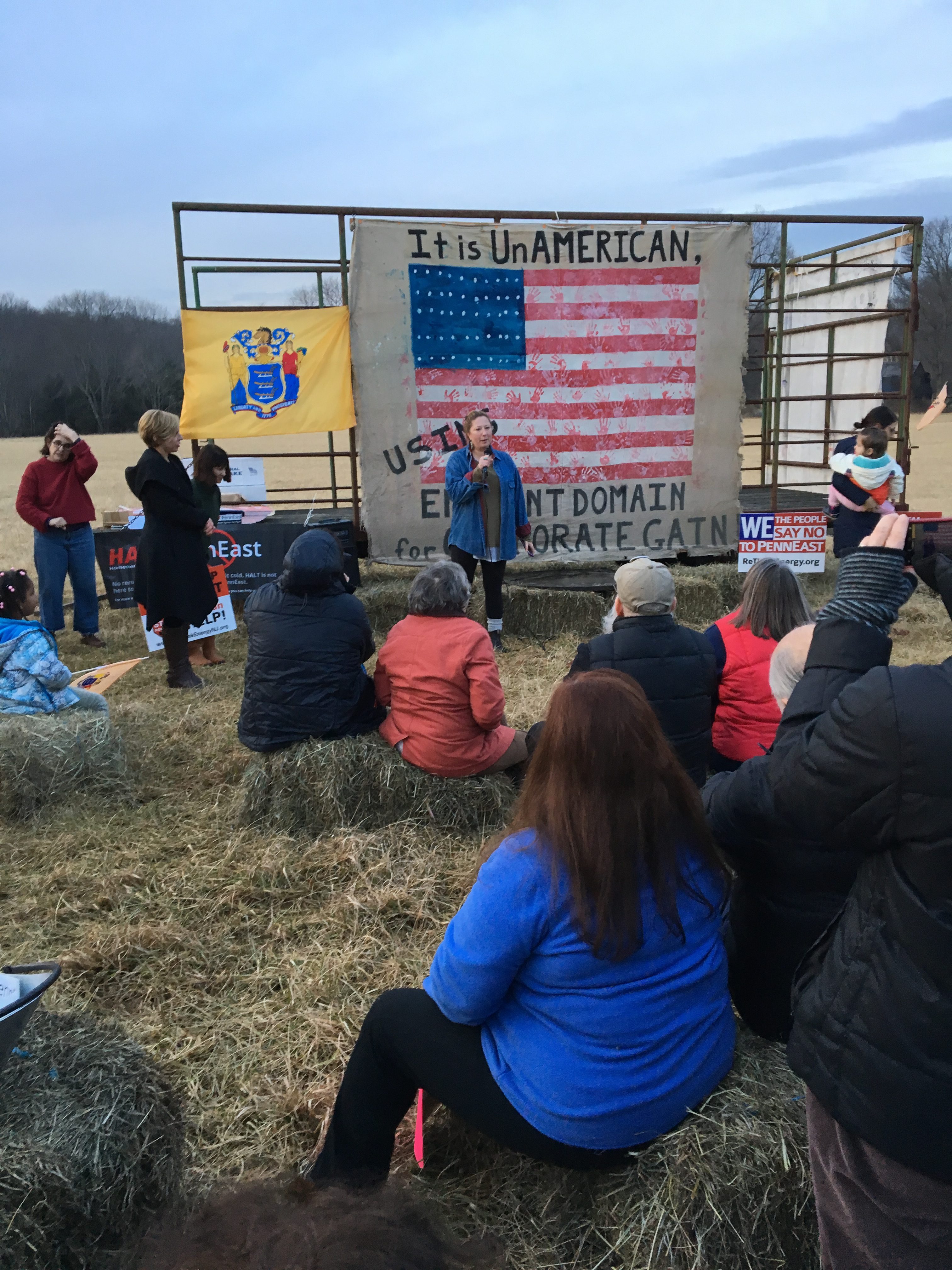
    On Friday, Jan. 19, the Federal Energy Regulatory Commission gave its approval to the PennEast pipeline. It’s a big setback, but the pipeline can’t be built without approval from the New Jersey Department of Environmental Protection. New Jersey already rejected an application from the PennEast Pipeline Company once. If enough of us keep raising our voices, we can show the Department of Environmental Protection that we don’t want a huge pipeline destroying protected open space and some of our cleanest waterways.
    What are you gonna do?
    “The fight’s quixotic,” my friends asserted. “It’s foolish to think you can make a difference.”
    “But if this pipeline gets built our neighbors will lose their land and our town could be flooded!!” I persisted.
    “All the same, Michael, you can’t stop a pipeline!”
    “I think it’s a cause worth fighting for, don’t you?”
    Thus ran the debate when I joined the fight to stop the PennEast pipeline. It was the first time I’d gotten involved in a political cause.
    My involvement started with a conversation, where I learned that the pipeline’s planned route goes right by Lambertville City’s reservoir, which has a dam rated high risk and is surrounded by granite, which will require blasting for the pipeline. The prospect of our city being flooded got my attention. I discovered that our neighbors in Hunterdon and Mercer counties could have their land taken away and would be living in the pipeline’s blast zone. I joined Homeowners Against Land Takeaway (HALT) and its Board of Trustees, questioned officials and candidates running for office, and do my best to keep the community informed.
    As I got involved in the fight, I came to understand some ugly things. The bad news is:
    Lesson 1: Five companies are investing in PennEast—New Jersey Resources, South Jersey Industries, Southern Company Gas, Spectra Energy Partners, and UGI Energy Services. They provide natural gas to customers and all proclaim the purpose of the pipeline is to provide low-cost gas to New Jersey residents. However, the natural gas market is flat. Their challenge is: How can we create a growth story for Wall Street to keep growing our stock prices? The answer? Build a pipeline! Why? Because the federal government, through the Federal Energy Regulatory Commission (FERC), guarantees a 14 percent profit to companies that build pipelines. When was the last time you were guaranteed a 14 percent profit?
    The Securities and Exchange Commission (SEC) filings of all five companies investing in PennEast state that New Jersey has enough natural gas to satisfy market needs through existing pipelines. The state Division of Rate Counsel, the agency that monitors natural gas supply and demand, concludes the same. That federally guaranteed 14 percent profit and its expected impact on stock prices is the sole reason for the PennEast pipeline. And the consequences for the little guy in cold cash? That 14 percent big corporate profit will come out of the pockets of ratepayers—you and me. So much for the myth of low-cost gas for New Jersey residents!
    Lesson 2: In grade school we’re taught that we’re a nation ruled by laws, not men. This, however, is only a half-truth. Under federal law, FERC guarantees a 14 percent profit, conditionally approves incomplete environmental applications, and enables eminent domain, allowing the seizure of citizens’ land. FERC enforces the law, as it interprets it. In the case of PennEast, FERC’s interpretation includes approving an environmental application so incomplete that it has been rejected by the U.S. Army Corps of Engineers and the state Department of Environmental Protection (NJ DEP). Nevertheless, the NJ DEP can use the federal Clean Water Act to stop pipelines. But here comes the hitch: NJ DEP can only stop a pipeline with the governor’s approval. Enforcement, in practice, is the governor’s decision.
    And the good news? New Jersey has a new governor, Phil Murphy. Murphy stated on videotape in Lambertville last year that the PennEast pipeline makes no sense economically or environmentally, and should be stopped. Suddenly the “quixotic” fight looks winnable!
    Who’s writing and enforcing our laws? Any law that enables a federal agency that (at best case) is influenced by the industry it regulates, or (at worst case) is controlled by that very industry is suspect. Yet this worst-case scenario is exactly what we have in FERC. The Clean Water Act is meant to protect our water and yet one governor can ignore it, and the next can chose to enforce it or not—it’s up to the governor.
    We must enforce existing laws that protect us and our children, and fight to pass new laws that benefit future generations. This is what we should stand for with renewed vigilance. The level of vigilance for any of us—the effort we put into educating ourselves, becoming involved in our communities, and voting—is a matter of temperament.
    Maya Van Rossum, the Delaware Riverkeeper, and her organization, the Delaware Riverkeeper Network, have vigilantly worked to protect the Delaware River for many years, fighting the negative impacts of state and federal policies on the health of the Delaware River and its surrounding communities.
    Maya has recently proposed a Green Amendment to the New Jersey constitution (see her inspiring site forthegenerations.org). Now, more than ever, with one of our major political parties denying climate change, we need to join her and other like-minded citizens to ensure our right to a clean environment, clean air, and clean water. If we don’t write and pass the laws we want, the fossil fuel and chemical companies will write the laws they want—laws that guarantee 14 percent profits and allow corporations to seize or pollute our lands.
    In times like these, when the White House talks about “alternate facts” and the influence of dark money permeates our lives, it’s easy to feel discouraged, depressed, and alone. I, for one, have discovered that it helps a great deal to focus on a cause and join forces with others, like HALT and the Delaware Riverkeeper Network, that are fighting to protect our rights and improve our lives.
    “What are you gonna do?” can be a resigned expression we use to evoke a sense of powerlessness, or a question we ask ourselves to determine how we can help to make our community a better place. Which will it be for you?
    Even if you’re not an active fighter, you can—and should— be an active voter. Important primaries are coming up in New Jersey in June, and elections will be held in November. If you aren’t inclined to get out and fight, get out and vote. If you are inclined to fight, there is plenty of work to do and organizations for every candidate—Indivisible, the Delaware Riverkeeper Network, and other groups support causes and candidates.
    The fossil fuel industry can fund candidates, but it cannot win if we vote its candidates out. Voting is the one thing all citizens can do. By voting for candidates that share our values, the next time an unneeded pipeline, or some other threat to the environment, comes our way we’ll have strong laws to prevent catastrophe and elected officials who’ll enforce those laws strictly in order to protect our land, our future and us.