INDIVISIBLE Lambertville NJ / New Hope PA

Category: Legislation

  • What the Heck is Going On In Our State Legislatures?

    Contributed by Amara Willey.

    Pennsylvania

    Although Democrats picked up a few seats in the Pennsylvania legislature and Governor Tom Wolf stayed in office, Republicans retained control of the House and Senate. We see the Republican caucus moving in a more conservative direction as moderates lost seats to Democrats.

    Nevertheless, there are several interesting bills to watch this year in Pennsylvania in the areas of fair pay, the environment, and legalization.

    • Changes to overtime pay – A bill mandating “white collar” employees be paid overtime if their weekly salary is under $610 per week. The salary minimum would increase after the first and second year respectively, forcing employers to pay overtime or increase wages. The state projects that the change would affect 460,000 workers.
    • Limiting methane from existing gas and oil wells – Stricter emissions standards were applied last year to new gas and oil wells. This bill would limit VOCs including methane gas from existing wells. Even though federal Environmental Protection Agency standards may be withdrawn, the state’s Department of Environmental Protection intends to push forward with this bill. Concerns about the bill involve potential costs.
    • Nuclear power – Lawmakers in the Energy Caucus recommended in a Nov. 2018 report that nuclear power be added to the list of alternative energy sources in the Alternative Energy Performance Standards program, which requires power distributors and generators to get 18 percent of their electricity from alternative sources such as wind, solar or biofuels by 2021. Two nuclear power plants are scheduled to close in the near future, the Three Mile Island plant outside Harrisburg in September 2019 and the Beaver Valley Nuclear Power Station outside Pittsburgh in 2021. PA’s current 9 reactors at 5 plants provide 42% of the state’s electricity. Decommissioning these plants would increase carbon dioxide emissions.
    • Marijuana legalization and expansion of medical cannabis – Since New York and New Jersey are likely to legalize recreational marijuana this year, Pennsylvania is taking another look at this issue, due to economic pressure from neighboring states. Governor Wolf has indicated he would sign this bill, but State Senate Majority Leader Jake Corman is opposed to the bill.

    New Jersey

    In New Jersey, hot issues also include the environment, fair pay and legalization. While a small minimum wage hike from $8.60 to $8.85 was achieved in 2018, Governor Phil Murphy failed to get the state legislature to pass the proposed $15/hour minimum wage or marijuana legalization that he had thought was a slam dunk. Both are being revisited in 2019.

    • Minimum wage – A bill, introduced in December, calls for a gradual increase in the minimum wage to $15/hour. The concern is that the higher wage will put N.J. at a competitive disadvantage though people might engage in more discretionary spending.
    • Earned sick leave – Regulations are proposed to a 2018 law requiring employers to allow eligible employees to accrue one hour of sick time for every 30 hours worked. Certain of the guidelines contradict the original statute and could provoke legal challenges.
    • Marijuana legalization – Legalization of recreational marijuana would include licensing production and sale of the substance and create the Cannabis Regulatory Commission (CRC) as an oversight organization. Outstanding issues include tax structure, how much power the CRC would have, and unionization of the industry.
    • Wind power – N.J. became the biggest single-state solicitor of offshore wind energy last year and will seek to expand the program in 2020 and 2022. The goal of the legislation is to provide 3,500 megawatts of offshore wind by 2030. The program will create jobs, boost regional economy, and help mitigate the effects of climate change, according to BPU president Joseph L. Fiordaliso, as reported in Law 360.

    While federal focus may have been diverted from these issues during the current administration, N.J. and Pennsylvania. at least are addressing these important liberal agenda items.

    Sources

    For PA: https://www.law360.com/articles/1113861/pennsylvania-legislation-and-regulation-to-watch-in-2019

    For NJ: https://www.law360.com/articles/1112578/nj-regulation-and-legislation-to-watch-in-201
  • How the Government Works – WYN2K

    Contributed by Deb Kline.

    A new regular feature in the ILNH Take A Stand newsletter is Civics 101: basic information about how the government works plus definitions to help cut through the jargon. Don’t be insulted, be informed. Share with others, educate your children and community. Information is power.

    How many members of the Senate and House are there in Congress?

    There are 100 Senate members, two from each of the 50 states. There are 435 House members with a varying number of members per state based on the state’s population.

    How often are members of the Senate and House elected?

    Members of the Senate are elected to 6‐year terms. One‐third of the Senate seats (those that are expiring) and all 435 seats in the House of Representatives are open for election every two years.

    What is the essential difference between the U.S. Senate and the House of Representatives?

    Under the Constitution, the two chambers are equal. Neither can promulgate laws without the other. Although they are equal, the Constitution does give certain exclusive powers to each chamber. Nominees chosen by the President to serve as judges, ambassadors, cabinet officers, and senior executives must be confirmed by the Senate. Treaties negotiated with foreign nations must be ratified by the Senate. The House has no formal role in either process.

    However, the Constitution gives the House the authority to originate all revenue (tax) bills and, through historical precedent, this authority has been extended to all appropriations (spending) bills as well. Although these money bills must begin in the House, the Senate has full opportunity to debate and modify the legislation sent to it by the House and, as with all bills, both chambers must pass a bill before it can be sent to the President.

    What is the difference between an appropriations bill and an authorization bill?

    An appropriations bill provides the legal authority needed to spend or obligate U.S. Treasury funds. Twelve annual appropriations bills fund the entire federal government. The bills are supposed to be enacted prior to the start of a new fiscal year, designated as October 1. Failure to meet the deadline results in the need for temporary short‐term funding or governmental agencies and offices will shut down. For example, funding for the Title VIII Nursing Workforce Education Programs at the Health Resources and Services Administration is contained in an appropriations bill.

    An authorization bill provides the authority for a program or agency to exist and determines its policy and structure. It also recommends spending levels to carry out a defined policy, but these levels are not binding. Authorizations may be annual, multiyear, or permanent. Expiring programs require reauthorizations. House and Senate rules require that authorization be in place before final funding decisions are made, though this rule frequently is waived or disregarded. The Patient Protection and Affordable Care Act is an example of an authorization bill.

    What is the difference between discretionary funding and mandatory funding?

    Discretionary spending refers to spending set by annual appropriation levels made by congressional decisions. This spending is optional, in contrast to entitlement programs (e.g. Medicare and Medicaid) for which funding are mandatory. For example, funding for the mental health programs at the Substance Abuse and Mental Health Administration is discretionary spending.

    Mandatory spending accounts for two‐thirds of federal budget. These funds are not controlled by an annual decision of Congress but are automatically obligated by virtue of previously enacted laws. For example, Medicare, Medicaid, food stamps, and social security are entitlement programs — funding for them falls under mandatory spending.

    What is a CR?

    A continuing resolution or CR is a short‐term or long‐term temporary funding bill that funds the federal government after September 30 until a permanent appropriations measure is passed and signed into law.

    What is a reconciliation bill?

    A reconciliation bill makes changes to laws required to meet preset spending and revenue levels. A reconciliation bill may be considered when permitted by a budget resolution passed by the House and Senate. The House Budget Committee packages the bills produced by the substantive committees of jurisdiction into one omnibus bill.

    What is an omnibus bill?

    An omnibus bill is a large bill that combines many different aspects of a particular subject. In the last few years, Congress has passed an omnibus appropriations bill to fund the entire government.

    When does the government’s fiscal year start?

    For the federal government, the fiscal year (FY) is October 1 to September 30 of the following calendar year.

    What does sponsor/cosponsor of a bill mean?

    A sponsor is the Senator or Representative who introduces the measure. A cosponsor is a member of Congress who joins in sponsoring legislation but is not the member who introduced the measure.

    Who is a Chair/Ranking Member of a committee/subcommittee?

    The chair of a committee is the presiding officer of a committee or subcommittee — this is usually based on seniority of committee tenure. The ranking member is the highest ranking (and usually longest serving) minority member of a committee or subcommittee.

    What is cloture?

    Cloture is the only procedure by which the Senate can vote to place a time limit on consideration of a bill or other matter and, thereby, overcome a filibuster. Under the cloture rule (Rule XXII), the Senate may limit consideration of a pending matter to 30 additional hours, but only by vote of three‐fifths of the full Senate, normally 60 votes.

    What is a markup?

    A markup is the process by which congressional committees and subcommittees debate, amend, and rewrite proposed legislation.

    What is unanimous consent?

    A procedure whereby a matter is considered agreed to if no Member on the floor objects. A unanimous consent motion can save time by eliminating the need for a vote. This procedure is usually reserved for non‐controversial bills that will easily pass either chamber.

    Extracted from: http://nacns.org/wp-content/uploads/2016/11/Civics101.pdf

  • Farms and No Food? – SNAP and the 2018 Farm Bill

    What is the Farm Bill?
    The farm bill is an “omnibus” piece of legislation that combines funding for a lot of different programs into one piece of legislation. The first farm bill was passed in response to the dust bowl in the 1930s and was meant to increase farm incomes and encourage conservation. Since then, the farm bill has grown in scope to include other programs, and would reauthorize various commodity, trade, rural development, agricultural research, and food and nutrition programs. Under the current farm law, program authorizations will expire Sept. 30 or the end of the applicable crop year.
    Historically, the farm bill has passed with considerable bipartisan support, but in recent years it has become more contentious as Republicans have ramped up their attempts to enact sweeping changes to Supplemental Nutrition Assistance Program or SNAP that may make it harder for people struggling to make ends meet to get food assistance.
    Current Status of the 2018 Farm Bill
    In May, the House version of the Farm Bill was defeated when 30 Republicans voted with Democrats to defeat the bill. On June 21, the House passed the bill by a narrow margin – 213-211. Democrats were unanimous in their opposition to the bill over severe cuts, new work requirements and expanded penalties for food stamp recipients. Twenty Republicans joined with Democrats in opposing the bill, but eight Freedom Caucus members flipped their votes from May and voted in favor of the bill.
    The Senate version of the bill passed out of the Agriculture Committee on June 13, with consideration by the full chamber expected before July 4. The Center for Budget and Policy Priorities (CBPP), a nonpartisan research and policy institute with a focus on reducing poverty and inequality, gives the Senate version a thumbs up for its handling of SNAP. According to the CBPP, the bill included a bipartisan nutrition title that would reauthorize the Supplemental Nutrition Assistance Program (SNAP, formerly food stamps) and improve SNAP’s program integrity and operations. The bill also would expand the 2014 farm bill’s pilot program to test promising approaches to job training and other employment-related activities for SNAP participants and would make targeted investments in SNAP that help seniors and people with disabilities, as well as Indian Tribes. And, the bill would make changes to and increase funding for certain grant programs outside of SNAP.[1]
    What’s Next and the Impact to SNAP
    While the Senate’s version of the bill may prove more palatable, the two bills ultimately need to be reconciled and currently there are wide differences – especially to the SNAP program. The House version seeks tighter work requirements for eligibility, increasing the work requirement age to 59 (from 49) and increasing penalties for those that fail to prove they’ve met the 20 hours per week work requirement with elimination of benefits for one year and up to three years. States also lose the flexibility to make the program easier for participants to use.
    This is part of a larger push to radically transform federal assistance programs. Since Trump took office, Republicans in Congress and in the administration have been adding or tightening work requirements for programs like SNAP and Medicaid. These restrictions don’t do anything to help the people served by these programs, but they do result in more people falling into poverty as the protections they rely on are stripped away.
    House Republicans have been playing a cynical game in selling their partisan farm bill. They say it has no SNAP cuts. Don’t be fooled: the House Agriculture Committee farm bill would cut or take away SNAP benefits from 1.5-2 million people, and we expect that amount will be much higher if it became law. Thousands of children would also risk losing their enrollment in free and reduced-price school meal programs.
    It’s important to stay tuned to what’s happening as it unfolds on a near daily basis. If a final bill isn’t authorized before the deadline of September 30, most likely there will be an interim extension.
    It’s also important to note that this enormous bill also has ramifications for renewable energy programs, the environment, small local farms and markets, and much more.
    For more information, read the CBPP’s report on the Senate version of the bill here, and read the organization’s statement on the detrimental impact of the House bill passed June 21 here.
    Call to Action:
    Leonard Lance and Brian Fitzpatrick voted against the House bill, breaking with party lines. The Senate still needs to call a floor vote, so determine your Senators’ stance on the Senate version, which is generally agreed to be more supportive of SNAP. Watch carefully as the bill goes into reconciliation – and demand that the final bill expand support for SNAP, lighten work requirements as well as provide flexibility for states to re-assess or waive work requirements in times of hardship or low job availability. Finally, any job training programs should be effective and applicable to employment opportunities that are available or can be made available within a reasonable geographic area of a recipient’s residence, and not just drain dollars from the program while for an unwieldy, bureaucratic ‘jobs’ program with an ineffective outcome.
  • If You Can Drive, You Can Vote

    In April, New Jersey passed the automatic voter registration law that addresses the 1.2 million adults in New Jersey who aren’t yet registered to vote. The new law, signed by Gov. Phil Murphy on Tuesday, Apr. 17, after previously being rejected by former Gov. Chris Christie, mandates that the Motor Vehicle Commission implement automatic registration and allows any state agency that collects documents and personal data to “establish a procedure to automatically register people to vote.”
    What this means is that agencies such as the Department of Human Services and the parole board could choose to register its clients to vote. Convicted felons still can’t vote under state law, and other parolees would have to wait until they finish their sentences.Vote NJ Update
    In Hunterdon County elections, 14 towns or townships have Democrats running for local seats. That’s the good news. The bad news is that 10 townships don’t have any Democrats running, including Alexandria, Bethlehem, Delaware, Franklin, Glen Gardner, Hampton, Holland, Lebanon, Milford and Bloomsbury, the last of which has no candidates for open seats. IndivisibleLNH members started talking to voters about the importance of voting in the upcoming elections last month, setting up tables in downtown Lambertville, outside Stockton Market, and at the Stangl Market in Flemington. They encouraged people to find out more about the candidates and to vote. Contact MJ Legere to volunteer!
    Upcoming events will help voters get a better sense of the candidates and give them an opportunity to support the candidates:

    A reception is being hosted as a fundraiser for Tom Malinowski on Saturday, May 19 from 4:00 – 6:00 PM, at the home of Joe and Lois Zarish, 153 Voorhees Corner Rd., Flemington, NJ.

    To RSVP or with questions, please contact Amanda Osborne at (908) 524-1802 or aosborne@MalinowskiForNJ.com.
    Hunterdon County Democrats will have a tent at the Chamber of Commerce event “Everything Hunterdon” on Saturday, June 2, at the County Fairgrounds. Stop by and meet members of the HCDC Party, as well as our Candidates running for Office.
  • Putting an End to Pennsylvania’s Extreme Gerrymandering

    Putting an End to Pennsylvania’s Extreme Gerrymandering

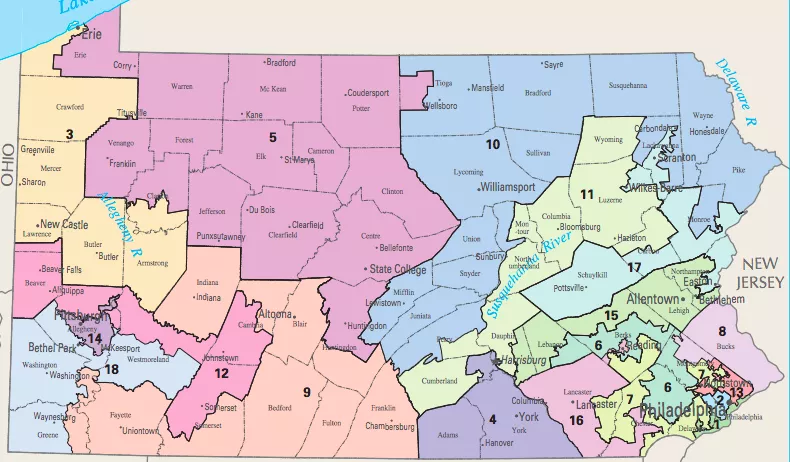
    “Goofy Kicking Donald” was but one of the jokes elicited by the erratically drawn Republican map of Pennsylvania’s congressional districts. (Please see the image.) Widely considered one of the nation’s most blatant cases of gerrymandering – whereby electoral districts are distorted to unfairly favor a given political party – it helped Republicans secure 13 of the state’s 18 districts. To put this in context, our state voted Democratic in presidential elections from 1992 until the disaster of 2016.

    Now, a successful challenge led by the League of Women Voters to correct this imbalance has prompted a legal and political battle, making frequent headlines in the national news.

    Specifically, the League’s June, 2017 suit prompted the Pennsylvania Supreme Court to rule on February 7th that the Republicans’ map violated the state’s Constitution and must be redrawn. Harrisburg was given an ultimatum to either come up with a more equitable map or face a Court-ordered redesign conducted by an outside expert. Harrisburg’s lame response led the Court to adopt a new map, created by Stanford University Professor Nathaniel Persily, a top election law scholar, previously selected by courts for redistricting work in five other states, including North Carolina. (No outsider, Prof. Persily taught at U Penn Law from 2000 to 2007.)

    When it comes to the new district for Bucks County, we gained a section of Montgomery County west of Sellersville that typically votes Democratic. According to Nate Cohn’s “The Upshot” in the February 22nd edition of the New York Times, this slight change flips us from “leaned Trump” to “leaned Clinton”, based on the 2016 presidential results. Cohn concludes that Republican Brian Fitzpatrick’s prospects in the 2018 congressional election exemplify “The sort of race that could be decided by the subtle shift ordered Monday.”

    In retaliation, the Republicans in Harrisburg filed both a motion to Stay the imposition of the new map with the US Supreme Court, and a suit to overturn it on US Constitutional grounds, with the Federal District Court. The legal action now centers on the request for Stay (filed by the State Speaker of the House and President of the Senate) and the suit (with several Republican Congressmen as plaintiffs).

    Both cite the election clause in the US Constitution stating that the “Times, Places and Manner of holding elections for Senators and Representatives shall be prescribed in each State by the Legislature thereof….” and contend that the Court’s action in imposing its plan violates that Clause. The suit quotes voting specialists (including Cohn) that the new PA Court-ordered plan is partisan in its result.

    Democrats maintain that the various Republican maps violate the PA state constitution’s requirement for fair elections. Since the State’s Supreme Court gave our Republican-dominated legislature the opportunity to correct this imbalance, and it failed to do so, the Court was within its rights to call upon a widely recognized independent expert to put it right.

    In sum, we are caught in a Catch-22. If the Constitution prevails over our state’s doctrine, then the shape of our voting districts – and thus, to a great extent, the electoral outcome — will be set by a legislature seeking to secure its dominance well into perpetuity. Truly responsive government, with elected officials who care about our everyday issues, as well as combating climate change, economic inequality, and discrimination, is founded on fair and open elections.

    CALL TO ACTION: Support Fair Districts PA: Fair Districts promotes legislation to place an independent citizens’ commission in charge of redistricting.