INDIVISIBLE Lambertville NJ / New Hope PA

Category: Social Justice

  • Time to THRIVE

    Time to THRIVE: From the multilateral racial, health, economic, and environmental crises to the THRIVE Agenda

    Contributed by Alexis Berends.

    In recent years, the deep links between racism and climate change have been coming to the forefront. Issues of Environmental Injustice have been highlighted in such catastrophes as Hurricanes Katrina and Maria, the fight to protect our water at Standing Rock, as well as within the Covid 19 crisis.

    Climate change and racial inequality are the direct result of industry – from clearing lands to grow cotton, sugar and tobacco in our early colonial history, to modern industrialization of agriculture, fishing, and the extraction of fossil fuels. In order to expand the colonial agricultural industry, the colonial countries in the Americas enslaved the Native populations, forcing them to exploit the lands they spent 11,000 years developing an intimate stewardship with. Others were expelled from their lands, or worse. Later, Africans were brought across the Atlantic in shackles, solidifying the industrialization of the Americas and forever imprinting a framework for systemic racism.

    These practices exist to this day, albeit in seemingly innocuous policies. We still force Tribal communities from their sacred lands to extract fossil fuels and build coinciding infrastructure under the guise of “energy security.” It exists in our use of immigrant labor, many with indigenous roots, to work our fields in illegal and inhumane conditions; in our crowded prisons where a disproportionate number of black and brown inmates make many of the products that proudly bare the label “Made in America”; and by underpaying workers in the critical healthcare and service industries which are traditionally dominated by women, especially women of color. Since its birth, America has been mistreating the environment, people of color, indigenous cultures and lands, and women alike. We can and must do better.

    BIPOC and marginalized communities bear the brunt of our unsustainable industries. For example, New Jersey is home to the most superfund sites per capita, most of which are in the Black and Latinx neighborhoods of Camden and Newark. Pennsylvania is #3 on the list of having the most superfund sites per capita, primarily in the communities surrounding Philadelphia and Chester counties. People in these areas commonly suffer from chronic lung diseases, such as asthma, which have exacerbated COVID-19 infections disproportionately. They have been screaming “I can’t breathe” for generations, and it’s no wonder that both Eric Garner and George Floyd had asthma.

    The COVID Crisis has put more pressure on our already fragile system. We face staggering unemployment levels, a broken economy, increased stress on women and mothers who are forced to assume multiple roles in unprecedented circumstances – especially women of color, and an overburdened healthcare system. At the same time, climate scientists are urging us to dramatically reduce carbon emissions by 2030 – just nine years away – and meet carbon neutrality by 2050 in order to slow global warming by 1.5 degrees celsius above pre-industrial levels. A dire existential threat is staring us in the face yet we have our blinders on.

    So how do we build a more just world? What policies are being introduced that could create a more sustainable future – environmentally, socially, and culturally?

    The THRIVE Agenda: Transform, Heal, and Renew by Investing in Vibrant Economy

    Now that the American Rescue Plan has been passed, the next step is to focus on how we will recover from the multifaceted crises we are currently facing. The THRIVE Agenda is a recovery package that calls for transformative, sustainable, and equitable change with meaningful action to respond to the Climate Crisis. THRIVE will provide access to healthcare, childcare, elderly care, and assistance for the disabled and chronically ill, and provides a framework for the just transition to sustainable development, particularly in the energy, agricultural and construction industries. Within this framework the resolution will focus on economic, racial, health, and environmental recoveries through 8 interrelated pillars:

    • Creation of 16 million good, safe jobs with family sustaining wages that have access to unions;
    • Investment in Black, Brown, and Indigenous communities;
    • Combating problems of racial and environmental injustice and ensuring healthy lives for all, as declared by the United Nations Universal Declaration of Human Rights of which the United States is a signatory;
    • Ensuring fairness for workers and communities affected by economic transitions;
    • Building the power of workers to fight inequality;
    • Strengthening and healing the nation-to-nation relationship with sovereign Native
      Nations and implementation of the United Nations Declaration on the Rights of
      Indigenous Peoples, adopted by the United States in 2010;
    • Averting climate and environmental catastrophe while building climate resilience to mitigate against the impacts of global warming and rising sea levels;
    • Reinvesting in public institutions that enable workers and communities to Thrive.

    Support for the THRIVE Agenda
    At present, the THRIVE Agenda is supported by 89 members of congress, 10 Senators and roughly 300 organizations, including leading labour unions such as the American Federation of Teachers; racial justice groups including Movement 4 Black Lives and the NAACP; environmental groups such as the Sierra Club, Greenpeace and Natural Resources Defense Council; indigenous groups, immigrants’ rights groups, women’s rights groups, faith groups, think tanks, and even Indivisible. In a survey done by Data for Progress, the majority of Americans, including in swing states and battleground House districts, support the 8 Pillars of the THRIVE Agenda with support for each pillar ranging from 54-77% of all registered voters, and as high as 72-91% of registered Democrats.

    Call to Action

    While there is growing support in both the House and the Senate, we still need to apply pressure on our elected officials. Many Democrats are still needed as cosponsors, and zero Republicans have yet to sign on. So far, only 3 congresspersons from both New Jersey and Pennsylvania respectively have signed, and both Malinowski and Fitzpatrick have yet to cosponsor.

    Reach out to your representatives and let them know we support the THRIVE Agenda. Give them a call, shoot them an email, and tag them on social media using the hashtags #TimetoTHRIVE so they can see how strong our movement is.

    It is time for us to recover as a nation by addressing the multilateral economic, racial, health, and environmental crises we have collectively experienced en masse this past year. We have been given an opportunity to rewrite the future of our country to ensure that it provides a healthy, economically and environmentally sustainable life for all. Don’t let this opportunity pass us by. This is our time to THRIVE.

  • ILNH FYI – Updates and Upcoming

    ILNH FYI – Updates and Upcoming

    Ready to get busy? Check out our Action Group Activities and Opportunities to Get Involved!

    Environmental Action Team Update – Lambertville is a hub of environmental action fueled by volunteers and we are only getting started! Indivisible LNH members and community allies have fought climate change this year with tenacity and innovation. Below is only a snapshot of the incredible work folks like YOU have been up to!

    PennEast – ILNH worked alongside incredible Stop PennEast allies like Lambertville CAP, Hunterdon and Mercer CAPS, HALT, Delaware Riverkeeper Network, Rethink Energy and Sierra Club NJ to support homeowners, urge legislators to act and demand permit denials from the NJDEP and DRBC. The NJ AG’s office won an important case in this fight, which will prohibit PennEast from taking state owned preserved lands along the route. The project is stalled, but we must remain diligent in advocating for NJDEP and DRBC to DENY all PennEast permits before them.

    Greening the Pipeline is an initiative and creative approach to fighting PennEast started by Lambertville resident Michael Heffler. Aggregation is a program available to towns to buy electricity. What the Greening the Pipeline program is proposing, is rather than just lower the cost, they change the mix of electricity to lower the natural gas used and increase the percentage of renewables. This hits PennEast in the wallet. Towns along the proposed pipeline route that have passed the ordinance to join the program are Frenchtown, Delaware Township, Kingwood and Lambertville. Pennington, Stockton and Alexandria are in the process of passage and discussions have started with Hopewell and West Amwell. This program will save all of us money, shrink our carbon footprint with no cost and no risk. Thank your town council for joining the energy coop, saving all of us money and taking it from the companies investing in Penneast.

    The Lambertville Environmental Commission in partnership with volunteers throughout the City launched the Ditching Disposables Initiative. The DD Initiative seeks to empower businesses and residents to minimize their consumption of single use plastics and transition to more sustainable alternatives. One of the kickoff events was the T-Shirts to Totes event, where residents turned unused t-shirts into reusable bags that will be donated to the local food pantries. The success of this event was due largely in part to the incredible dedication of Cindy Sternfeld and her team of ILNH volunteers who rocked it at the sewing machine! Ditching Disposables has continued to roll out with programs like the Sustainable Business Forum and Green Innovator Award! To learn more follow Lambertville Environmental Commission on Facebook.

    On Oct 1 the ILNH Environment Team was joined by Student Climate Strike Organizer Patrick Artur and Eric Benson from Clean Water Action NJ. Patrick shared what inspired him to organize the Climate Strike and how students can inform future Environment Team actions. Eric Benson from Clean Water Action shared about the top issues facing NJ today and what we can do to address them!

    Call to Action!
    Urge NJDEP and DRBC to Deny All Permits to the PennEast Pipeline
    Sign petition to the NJDEP https://www.greenactions.org/stop-penneast?sc=hlt&fbclid=IwAR2SlWQMpEGr9jPNtQg8EGX3BMoQE-3T-iK6PN6FPYc23xo6KYv_k955HF8
    Sign petition to the DRBC
    https://docs.google.com/forms/d/e/1FAIpQLSfZvhXXAppbzQKrZ_5s6lnIdHdUiyIg0hO0_2SN5FsV-8qUZQ/viewform

    Civil Rights Action Group is Active as Heck! – check out the upcoming events. Contact Shara Durkee for more information, locations and to RSVP.

    • Book Club Meeting – Wednesday, October 9 at 6:30 pm in Lambertville – Subject is Solitary by Albert Woodfox, who served more than four decades in solitary confinement – 23 hours a day in a 6-foot by 9-foot cell – for a crime he didn’t commit. Even if you don’t have time to finish or haven’t even started the book, please join us for a lively discussion!
    • Volunteer at Books Through Bars in Philadelphia – Saturday, October 19, 11 am – 2 pm
    • Civil Rights monthly meeting – Monday, October 21 at 6:30 pm in Lambertville.
    • Presentation and Discussion with Elaine Buck and Beverly Mills, authors of If These Stones Could Talk: African American Presence in the Hopewell Valley – Saturday, October 26, 3-5 pm – Methodist Church, 108 N. Union, Lambertville – A decade ago, Beverly Mills and Elaine Buck began formal collaboration into researching the lives of their African American ancestors, most of whom were likely to have been brought up the Delaware River as slaves to–what is now the Hopewell Valley region in Central New Jersey. Active community members, Mills and Buck both serve on the board of the Stoutsburg Cemetery Association, a burial ground for African American residents and veterans in the region.
    • Tour of Eastern State Penitentiary in Philadelphia – Saturday, November 9, 11 am – This one hour tour highlights Eastern State’s fascinating 142-year history, revolutionary architecture, notorious inmates and world-wide influence. The tour will also focus on criminal justice. For the group tour, prices are $11/adults, $10/seniors, $8/students ages 7-12.
    • Workshop “Dismantling the Racism Machine: Myths, Taught to White People that Perpetuate White Supremacy – Wednesday, November 20, 6:30-8:30 pm, Lambertville Public Library – With Karen Gaffney, author of Dismantling the Racism Machine: A Manual and Toolbox.

    Join ILNH Leadership Team! We have roles to fill and need your help. We need to flesh out our GOTV team now, including an overall lead, NJ and PA specific leads, and those who want to focus their energies on righting the ship by educating and encouraging voters through November 3, 2020.
    We’re also looking for someone to head the Swag team, including identifying merchandise to sell, caring for and maintaining inventory and adding to the ILNH finances by successfully SELLING the stock at meetings and other appropriate locations and events.
    In addition, a Fundraising co-lead will join Diane Abatemarco to help plan activities and other mechanisms through which we can support the financial health of ILNH.

    Write for Us! The ILNH Take A Stand Newsletter needs writers. Part of the ILNH mission is educating our community and one of the ways we do so is through this newsletter. Contribute a single piece to express your passion and/or knowledge, or be a regular staffer who keeps their finger on the pulse of the incredible amount of news and subjects that help us be informed citizens – the choice is yours. Contact Deb Kline via email or Slack.

  • ILNH Civil Rights Group Movie Screening: ’13th’

    Contributed by Lisa Bergson.

    The ILNH Civil Rights team invites you to join us at the Lambertville Acme Screening Room (S. Union Street) on Sunday, June 30, from 1:00 to 3:00 p.m. for the “13th”, the powerful documentary on mass incarceration directed by Ava DuVernay.

    “We’re giving you 150 years of racism in 100 minutes,” DuVernay told The Atlantic.  “This film was 150 years in the making.”

    “13th” will be followed by commentary from ILNH member and Lambertville resident Prof. Ralph Young, author of Dissent: The History of an American Idea.  

    Notably, DuVernay also directed “Selma” and the upcoming four-part HBO series, “When They See Us”, about the highly sensationalized, false conviction of five African-American teenagers for the 1989 assault and rape of the Central Park jogger.  Her filming took place at the same time that Justice Brett Kavanaugh’s nomination to the Supreme Court was under scrutiny, leading DuVernay to wonder, “What kinds of boys truly get to be young and carefree, and what others are indicted on sight?”

    From her earliest work as a filmmaker, DuVernay has delved deep into the issue of mass incarceration, the virtual enslavement of African-American males, under the aegis of the 13th Amendment (italics ours): “Neither slavery nor involuntary servitude, except as a punishment for crime whereof the party shall have been duly convicted, shall exist within the United States.” Of the impact her film achieves, DuVernay states, “Look at this picture.  Look where we are. After you see ’13th’, silence is consent.”

    Sources:

    • “Let the Record Show”, Mattie Kahn, Vogue, p.74, June, 2019.
    • https://www.theatlantic.com/entertainment/archive/2016/10/ava-duvernay-13th-netflix/503075/
  • Same, Same, But Different: Diversity in Communities, Workplaces and Schools

    Contributed by Deb Kline.

    The business world has extolled the benefits of diversity for the past decade or more. Encouraged by the findings of several studies, many large corporations have held diversity trainings, have diversity officers, celebrate various cultures and ethnic groups with special events, days or weeks. Despite all this, however, according to a 2017 report by Diversity Best Practices, 93% of Fortune 1000 companies are led by men, most of whom are overwhelmingly white. (For more statistics on diversity in the workplace, see this link.) (more…)

  • Springboard to Criminal (In)Justice – Bearing Witness

    Springboard to Criminal (In)Justice – Bearing Witness

    Contributed by Lisa Bergson.

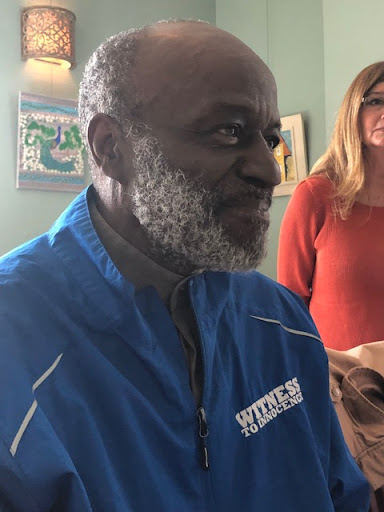
    Shujaa Graham stops short at the sight of the solitary-cell 6’ X 9’ dimensions measured with blue tape on the linoleum floor of the Acme Screening Room lobby in Lambertville, N.J. It’s the afternoon of “Shatter the Silence: Criminal (In)Justice,” a program organized by Indivisible Lambertville/New Hope’s Civil Rights Action Team, where Graham is scheduled to speak.  As attendees file by, many glancing in horror at the cell’s cramped quarters, he steps inside the bounds of a world he knows all too well. Exonerated after five years spent in isolated confinement on San Quentin’s death row, Graham has dedicated himself to Witness to Innocence, a Philadelphia-based organization led primarily by exonorees, seeking an end to the barbarism of the death penalty.

    Out for close to 37 years, Graham stands at the foot of the taped, narrow rectangle labelled “bed,” his eyes far away as he points about, like a tour guide in hell, “It was just like this, only no window, and I don’t remember no desk.  Just half-hour a day to get out for a shower.”

    The United Nations equates more than 15 days in solitary to torture.  But, right here in New Jersey, we rank third in the nation, just behind Nevada and Massachusetts, when it comes to women inmates stuffed in isolated confinement.1 At Edna Mahan, the state’s only prison for women located in Clinton, NJ, the average number of days individuals are so-called “segregated” is 338.

    Any worries the event’s organizers had about turnout on this sunny spring afternoon are dispelled by the over-capacity turnout of 72 folks who showed up to hear Graham and the director of Trenton’s Campaign to End the New Jim Crow (CENJC), Patrick Hall. Patrick’s organization is part of a nationwide movement, inspired by Michelle Alexander’s award-winning book, The New Jim Crow, exposing our racist system of mass incarceration and its destructive impact on minority communities, along with the exploitation of prison labor by many of our country’s biggest businesses, including Walmart, Procter & Gamble, and MacDonald’s, according to Hall.

     “Mass incarceration is about money,” Hall tells the gathering.  “Mass incarceration is an extreme rate of imprisonment. They keep locking people up. Crime is going down.  But, mass incarceration is a business.” Not only are private prisons a big and burgeoning business,2 but their expansion is becoming an economic bedrock of the often poor, white, and rural communities where they are located.3 (Any one listening to National Public Radio during the recent federal government shutdown would have been riveted by the story about unpaid prison guards working in a correctional facility in Oakdale, Louisiana, and what those jobs meant to their community.)

     “Private prisons have contracts, and the cities and counties are getting paid for them too.  They have to keep them filled,” Hall says, matter of fact.

    Although their paths took widely divergent trajectories, both Hall and Graham share a childhood marked by loss and instability.  “Between the first and third grade, I went to 11 different schools,” recalls Patrick, noting that his father was an alcoholic and the family “moved around a lot.” Seeking work, Graham’s parents left their boys with their grandmother when they moved to Los Angeles. Not long after the family was reunited in the depressed South Central neighborhood, Graham, then 12, got caught up in the gang world. “That’s where my troubles begin,” he laments, adding: “They were recycling me in and out of juvenile hall.”

    At 18, he wound up in Soledad State Prison, where his life was forever changed by an encounter with an older inmate who encouraged him to improve his reading skills and learn history “to understand how you got here.”  As Graham recounts: “I started reading right then, and I renounced the gangs. We started organizing.” After moving to another facility in Stockton, Graham got caught up in a prison uprising:

    “On September 27, 1973, a human being was killed. I would have make them kill me that day if I had a clue of what I would face for the next five years.  San Quentin had the gas chamber, and that’s where I went.”

    Framed for his activism, Graham’s first trial ended with a hung jury.  His next two trials were overturned, based on the systematic selection of all white juries. “I never contemplated suicide, but there were nights when I went to bed, it would be OK if I didn’t wake up.” By the fourth trial, Graham was given the chance to help select the jurors, surprising his lawyers by picking a white banker. (“I could tell he was intelligent.”)  He goes on, “The jury deliberated for four days. I was up in a cell, just like the one you see out there. I was pacing.”

    Such a plight is not unlike that of many on Pennsylvania’s death row.  Pennsylvania is the one state in the nation that does not provide funding for the defense of poor defendants, who comprise over 80% of those accused. It cedes this obligation to the counties, leading to a big disparity – in fact, the largest in the U.S. – of capital sentences from county-to-county. The result is a haphazard and inconsistent patchwork of attorney appointment protocols, literally playing Russian Roulette with defendants’ lives.4

    In the Keystone State, some one-third of the convictions on our death row have been overturned as a result of poor lawyering.  Execution of those denied fair and proper representation is tantamount to state-sponsored murder. For this reason, in February, the American Civil Liberties Union and the ACLU of Pennsylvania filed a friend-of-the court brief in February, asking the state Supreme Court to hold PA’s capital punishment system in violation of the PA constitution!

    “I’m tough on crime,” says Graham, by now a grandfather of five. “But, I am against the death penalty.  We don’t need more victims.”

    “I never wanted no one to have to experience what I had experienced,” Graham intones. “Every day, I wake up and think about where I would be if California had its way.”  After offering a standing ovation in tribute, audience members in tears come to hug him, offering their support, some sharing their stories of incarceration.  Graham is crying too, but not for himself. May his tears for those men and women still on death row, may they not be in vain.

    Calls to Action:

    • Curb Solitary in NJ: Tell your New Jersey representatives to support the Isolated Confinement Restriction Act (bills A-314 and S-3261, Assembly and Senate respectively). The bills limit solitary to 15 days at a stretch and ban it for pregnant women, inmates 55 and older, those 21 and younger, as well as folks suffering from mental illness and disabilities. It can only be used on those posing a “serious and immediate risk of harm to self or others” and after all less restrictive measures fail.
    • Stand up for Witness to Innocence: Learn about and support this vital and inspiring exoneree-driven organization: Witnesstoinnocence.org
    • Link arms with our Trenton-based Campaign to End the New Jim Crow: endnewjimcrownj.org
    • Support the PA ACLU: “Defending Liberty Where It Began!”
    • JOIN US! Join the ILNH Civil Rights Action Team as we continue to educate ourselves and our communities about the plight of our nation’s most oppressed populations, promoting sweeping and powerful change for the better.

    Footnotes and sources:

    1. “Reforming Restrictive Housing: The 2018 ASCA-Liman Nationwide Survey of Time-in-Cell”, The Association of State Correctional Administrators, The Liman Center for Public Interest Law at Yale Law School, ASCA-Liman Restrictive Housing 2018 revised September 25 2018, October 2018, pages 14-15.
    2. Michelle Alexander, The New Jim Crow, Mass Incarceration in the Age of Colorblindness (New York: The New Press, 2012), 230.
    3. Ibid., 232.
    4. ACLUPA.Org/News, “ACLU Urges PA”