INDIVISIBLE Lambertville NJ / New Hope PA

Category: Immigration

  • Just the Facts – Refugees

    • There are 25.9 million refugees worldwide, half of them children.  Refugees are people forced to flee their country because of violence or persecution.
    • An additional 41.3 million people are internally displaced, meaning they were forced to flee their home but did not cross an international border.
    • And … every day, 37,000 additional people are forced to flee their homes.
    • Every year, refugees walk over 1.2 billion miles in search of safety.
    • Over half of all refugees are hosted by only 10 countries, including some of the poorest countries in the world, such as Sudan, Uganda and Pakistan.
    • In fiscal year 2018, the U.S. admitted only 22,491 refugees.  In October 2019, the U.S. admitted zero refugees for the first time in the 30 years in which monthly records have been kept.

    To help refugees this holiday season:

    Sources:  https://www.amnesty.org/en/what-we-do/refugees-asylum-seekers-and-migrants/global-refugee-crisis-statistics-and-facts/ and https://www.unhcr.org/en-us/figures-at-a-glance.html and The Nation.

  • No Peace, No Freedom for Immigrants, Refugees and Asylum Seekers

    No Peace, No Freedom for Immigrants, Refugees and Asylum Seekers


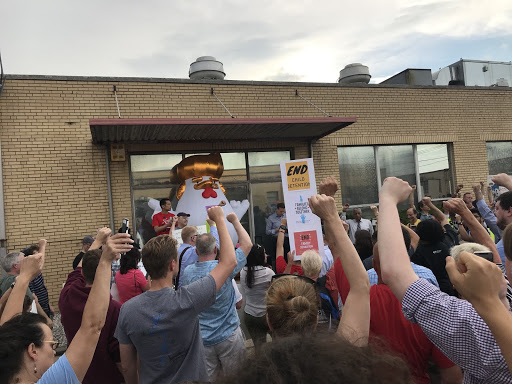
    Several ILNH activists participated in protests against the treatment of immigrants, asylum seekers and refugees in both New Jersey and Pennsylvania. In the photos, Indivizzies Susan Shapiro and Terry Rice stand with other protesters at the Elizabeth (NJ) Detention Center. 


    Headline News: Man and Daughter Drown in the Rio Grande Trying to Reach America 

    Red, White and BlueJohn Smith

    • In the photograph she wears red pants; 
    • her father, blue shorts. Their skin’s white 
    • but not as white as the white on our flag.
    • She is snuggled tight under the back 
    • of Daddy’s black T-shirt as if in a sling-pouch,
    • one arm slung around his neck, 
    • her stubby fingers tangled in the wet weeds 
    • of his hair, both of them afloat face down 
    • in muddy water, their limp bodies run aground 
    • too late. Either she held on even after 
    • he thrashed, spasmed, bucked like a terrified bull, 
    • then went slack; or she would not let go
    • while he slapped water, one exhausted arm 
    • after the other, the distant shore 
    • inching closer. She held tight and squirmed,
    • kicked, cried out for her mother then stopped 
    • and sagged heavy as a backpack full of stone. 
    • What if he had to bear her dead weight 
    • until his lungs burst into flames, 
    • and he breathed the river in 
    • to stop the burning, then sank? 
    • Who can imagine such suffering,
    • such desperation that risking 
    • the Rio Grande was the best option 
    • to begin with? I heard someone say, 
    • At least she won’t be separated 
    • from her father and caged 
    • in a concentration camp.
    • Is that what’s left of mercy 
    • in this country? Is our compassion 
    • so limited that callous sarcasm 
    • is all we have to offer? Do we just sigh
    • and rant online for a couple days 
    • then forget about a daughter’s arm 
    • wrapped around her father’s neck,
    • hanging on to the only hope she knew
    • drowning in the dream of America? 

    John Smith has published poetry in numerous literary journals. His book, Even That Indigo, is available on Amazon. John lives in Frenchtown, NJ with the henna artist/calligrapher, Catherine Lent.

  • SPRINGBOARD to Immigration Advocacy and Reform

    Contributed by Deb Kline.

    Review and Action from ILNH’s First Springboard Meeting

    The first-ever ILNH Springboard Meeting hosted Johanna Calle, director of the NJ Alliance for Immigrant Justice (NJAIJ), who spoke to a crowd of 20 Indivizzies and friends about the issues facing immigrants on the federal and state level.  The Alliance is a statewide coalition of more than 40 faith, labor and community organizations that promote policies in NJ to advocate for and support documented immigrants and those seeking status.  

    Johanna spoke about the changes in immigration policies over the past 20 years, noting that the window of opportunity for an immigrant to gain residence in the U.S. has increasingly narrowed. Today, an immigrant seeking permanent residence requires that they must be directly related to a U.S. citizen, i.e., spouse or child. She also explained that many ‘unlawful’ immigrants are those that have overstayed a travel visa or had an expired Green Card, in which case they are banned from the U.S. for ten years.

    “The reality is, the immigration laws are broken,” said Johanna. Her own family came to the U.S. in 1995, and was able to get Social Security numbers, driver’s licenses, open a business. But that all changed after September 11, 2001, when laws began to tighten following the terrorist attacks.

    The need for wholesale immigration reform is widely recognized across the political spectrum, but broad disagreement on how to go about it has necessitated that advocacy groups focus on smaller pieces of the issue to make headway. In the meantime, organizations like NJAIJ are putting efforts into helping those at risk avoid deportation, and advocating for policies that limit the level of reach of Immigration and Customs Enforcement (ICE) and Customs and Border Patrol (CBP).  

    Currently, NJAIJ has two focus areas: In addition to family unity and protection from deportation, the organization is advocating for the expansion of driver’s licenses to immigrants seeking status. With the campaign, “Let’s Drive NJ,” the organization works to bring NJ in alignment with the other twelve states which allow undocumented immigrants obtain licenses. Doing so will help increase public safety, help the state’s economy and increase the well-being of families. A note here that although the NJAIJ is a NJ-based organization, Pennsylvania has a similar program working to expand access to driver’s licenses.

    The Springboard meeting on March highlighted the many actions Indivisible members can advocate for on the state and local levels of government. This is very good news.  Possible activities of our group include monthly postcard parties, urgent PRN post card parties, organize trips to the Elizabeth Detention Center, monthly calls to state/local officials, etc. In addition, we will be maintaining ongoing contact with Johanna, to stay updated and send out alerts to Indivisible when there is an action that needs to be taken.

    On the schedule: A follow up meeting of the NJ Immigration Advocacy team to organize actions will be on April 4 at 7:30 p.m. at the Lambertville Free Public Library.

    Eye Openers:

    • ICE has funding to detain 40,000 people; however, it currently holds 50,000. There is a huge funding gap that needs to be made up.
    • NJ has the third largest number of immigrants in the country and the fifth largest number of undocumented immigrants.
    • Detention pays: In NJ, counties and corporations are paid $170 per day for each person who is housed in a detention center.
    • NJ counties Essex, Hudson and Bergen, are currently receiving funds for detention housing that go directly into the county budget.
    • Witnesses and victims of crimes who fear their personal detention or deportation avoid reporting incidents to law enforcement as ICE patrols the courts and works with local police and organizations.
    • Language is important: Use “fair and welcoming” instead of “sanctuary.” The latter implies that immigrants are safe and that the municipality may be breaking the law.
    • “Affiliation” with a gang is a factor leading to deportation; however, young people have been picked up simply for wearing a personal item of clothing that happens to be one of the colors of a gang.  
    • Undocumented immigrants pay taxes and Social Security, but are blocked from receiving any of the benefits.
    • At the federal level, NO new laws have been passed with regard to immigration policy and access to citizenship. All changes have been made at the administrative, Department of Homeland Security level.

    Noteworthy:

    • In NJ, new rules went into effect on March 15, implemented by the NJ Attorney General, called the “Immigrant Trust Directive.” This trust outlines when the state’s 36,000 police officers can ask people about their immigration status and cuts back on cases where police can cooperate with federal Immigration agents. The rules also limit when county jails can detain prisoners who are in the country illegally.
    • In the U.S. Congress, HR 6 was introduced in the House the week of March 11, and deals with Dreamers and those with Temporary Protected Status. Representatives Tom Malinowski and Bonnie Watson-Coleman are co-sponsors.  

    In Pennsylvania – organizations that provide support and advocacy for immigrants include:

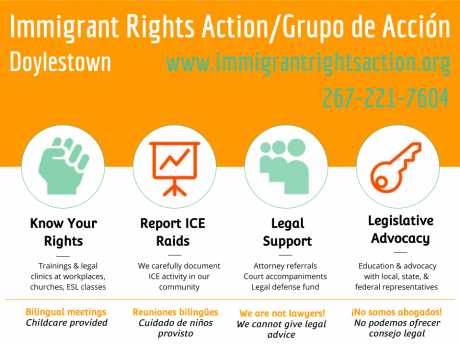
    Immigrant Rights Action/Grupo de Acción of Doylestown is a way to get involved with local actions. The group has developed packets to enable constituents to talk to their legislators, and works in conjunction with other groups to provide local trainings for allies and immigrants. The organization recently incorporated and has established office space to meet with community members. Group meetings on the first Wednesday of the month. Reach out to Sue Ann DeVito if you would like to join.

    MILPA spearheads the legislation for Pennsylvania drivers licenses. When the legislation is introduced, we will need to call state legislators for support.  Chris Rabb, State Representative (200th HD) , is working on introducing a bill.

    Shut Down Berks is a coalition working on shutting down the Berks Detention Center. They organize vigils, rallies, postcard parties and legislative advocacy. Follow their page on Facebook to see upcoming calls to action.

    PICC (Pennsylvania Immigration and Citizenship Coalition) has many resources to help the community on their website. The activist tab has a plethora of information, and areas you can take action. Recommended: sign up for their STOP THE HATE CALLS.

    Welcoming The Stranger is in Bucks County and has free classes and resources for immigrants and refugees.

  • Immigration True or False?

    Immigration True or False?

    Courtesy of the Immigrant Rights Action Group of Doylestown.

    Propaganda is a powerful tool. Truth is a powerful antidote.

    The current administration has created a false narrative around the story of immigration as a way of dividing and isolating people from one another, and of making us afraid. Stoking fear is a strategy to gain control. People who are afraid are more apt to compromise on things they believe in.

    You can help to counter the dangerous, racist narrative around immigration. In an era where traditional sources of information are no longer trusted, you have more power than you know by simply having personal conversations. Speak with someone; a neighbor when cutting the grass, a co-worker at the lunch table, a friend at a party, and counter the narrative.

    Here are the facts:

    Immigrants make our communities less safe: False!

    Undocumented immigrants represent only 3.4% of the total US population. And Immigrants are 25% less likely to commit a crime than native-born Americans. We would be made much safer by focusing our resources on other issues such as gun violence, mental health, or substance abuse prevention.  

    Immigrants are milking the American taxpayer: False!

    The most recent IRS data, from 2015, shows that the agency received 4.4 million income tax returns from workers who don’t have Social Security numbers, which includes a large number of undocumented immigrants. That year, they paid $23.6 billion in income taxes.  They paid billions of dollars for benefits they will never be able to use.

    Immigrants are taking jobs that Americans need: False!

    A recent study estimated the consequences if all undocumented New York agricultural workers are deported: There would be a 24 percent fall in farm production (amounting to $1.37 billion in commodity value lost) and a knock-on effect of nearly 45,000 lost jobs across the state. In 2017. Fortune Magazine reported that in two California counties alone, 13 million in crops were left unpicked, and predicted higher prices for produce.

    Immigrants are flooding the southern border: False!

    According to data from the Department of Homeland Security, illegal crossings are now at historic lows—about one-fifth of what they were at their peak in the late-1990s and early-2000s.

    Immigrants can just get in line and follow the legal process: False!

    The fact is there are different lines for different people. Certain types of people have to wait decades to apply for an immigrant visa, while others take a much shorter amount of time. A U.S. permanent resident’s unmarried son or daughter, who is 21 years old or older, will have to wait roughly 20 years to file an application for an immigrant visa if they’re from Mexico, according to the State Department’s visa bulletin.

    Criminal groups like the MS-13 are taking advantage of the U.S. asylum or immigration system to place gang leaders in the United States. False!

    Of all unaccompanied minors apprehended at the southwest border since 2011, 0.02 percent were either suspected or confirmed to have ties to gangs in their home country, according to U.S. Border Patrol Acting Chief Carla Provost. That’s 56 minors out of 250,000. The MS-13’s membership makes up less than one percent of all criminally active gang members in the United States and Puerto Rico.

    Learn more about facilitating dialogue at www.better-angels.org

    Support the Immigrant Rights Action Group of Doylestown Legal Defense Fund, which has raised more than $9000 since we formed in 2017. 100 percent of this money has been used to secure ethical immigration attorneys for neighbors, co-workers and community members facing deportation.

  • A Veteran’s Perspective

    Contributed by Terry Rice. 

    In just a few days, we will commemorate the 100th anniversary of the end of World War I, a war in which 65 million soldiers from 30 nations fought for four years resulting in the deaths of over 20 million people.  Hostilities ended at 11 AM on November 11th, 1918 following the signing of an armistice between the Allied powers and Germany.  The anniversary of that agreement has been observed every year since then. At first, Armistice Day was meant to celebrate and promote peace while honoring those that had served in World War I.  In 1954, President Dwight Eisenhower renamed the anniversary to Veterans Day and expanded the honorees to include those who served in World War II and the Korean War. More recently, Veterans Day has become a day where we acknowledge and honor anyone who has served in the US Armed Forces.   But for me as a Veteran, November 11th is a time for reflection.  

    Veterans day reminds me that I come from a long tradition of military service.  I have more than a dozen relatives that have served or continue to serve, including my father who spent 22 years as a non-commissioned officer in the US Army.  In that tradition, I ended up going to West Point and serving 10 years as a US Army Officer. One of the proudest moments of my life was when my father rendered me my first salute.  

    Veterans Day is an opportunity for those of us that have served to be a bridge to others that have little to no experience with the military. Numerous studies have shown that there is an increasing divide between the military and the civilian communities. Today less than 0.5% of the US population currently serves on active duty, an historic low, making it unlikely for the average person to have any interaction with someone who is serving.  Military base consolidation over the last few decades has only exacerbated the issue, to the point that about half of the 1.3 million active duty personnel live in massive, self-contained military bases in just five states: California, Texas, Georgia, North Carolina, and Virginia. Furthermore, today’s recruits disproportionately come from families where a parent or close relative has served, thus perpetuating the isolation.

    This divide makes it harder for the citizens of the US to effectively exercise civilian control over the military when voting on candidates and military related issues. At the same time, the isolation also makes it hard for the military to reflect society’s priorities, if the military increasingly becomes a secluded warrior class. Therefore it is important for those of us who have served and now live in non-military communities to share what it is like to be in the armed forces, to identify and explain the challenges our service members face, to explain the impact that seventeen continuous years of combat have had on our military, and to continuously debunk myths that arise about the military.  

    The Shift in Veterans’ Political Affiliations

    The latter point is one that I have dealt with quite a bit recently.  I am constantly amazed by how many people upon hearing that I am a former Army Officer immediately assume I am a Republican.  This faulty assumption holds true across the political spectrum; people tend to think members of the military vote staunchly Republican; especially members of the officer corps.  While it is true that the military generally leans Republican, which is reflective of the higher percentage of men and recruits from rural areas, recent years have seen a significant increase in military members affiliating as Independents.  Almost all of that shift has come from members formerly identifying as Republican. In fact, one recent survey showed nearly 40 percent of the military no longer affiliates with either major party and that percentage appears to be increasing.  

    Those of us who have served need to make sure we are engaged with our elected officials.  Just as the percentage of Americans who are veterans has declined, so has the share of Congress members with prior military service.  Currently, only about 20% of Congress members have any prior military service. When one considers active-duty experience (not just Reserve status), the numbers are significantly less.  This is a significant decrease from 65% just just a few decades ago.

    Given the tremendous authority Congress has over military, it is critical that veterans communicate with their senators and representatives either directly (e.g., phone calls, letters, and in person meetings) or indirectly through veterans’ advocacy groups. Veterans Day is a great time to initiate or re-initiate this contact.  Veterans should also consider voting for the significant number of veterans running for Congress in 2018 — many of whom are running as Democrats.

    Immigrants in the US Military

    Those of us who happen to be both Veterans and immigrants must get involved in the current debate on immigration. While many people may assume that intersection is very small, the Migration Policy Institute estimates there are approximately 511,000 immigrant Veterans of the US military, including those from Mexico (16%) and the Philippines (13%).  Currently, the appalling treatment of immigrant service members and their families threatens the security of the United States. The current administration is planning to cancel the Military Accessions Vital to National Interest (MAVNI) program that allows certain legal immigrants with critical skills such as strategic languages, key technical competencies, or medical education to earn green cards via military service. More than 10,000 soldiers have entered this program since 2009.  The administration is considering the cancellation of more than 1,000 contracts with individuals that were planning to enter the military in the coming year. Many, if not most of these individuals will have to return to their home countries. This would be a significant loss of critical talent when the military has a hard time recruiting these skills. This country has a long history of immigrants serving in the armed forces particularly during times of conflict. In fact, more than 20% of the Congressional Medal of Honor recipients were immigrants including at least one, Silvestre Herrera, who was “undocumented.”

    Even more disturbing is the fact that as many as 11,800 current service members are now dealing with the possibility of having a spouse of family member deported after a recent change to immigration policy.  Some of these family members have been in the US for decades and saw their service member deploy to Iraq and/or Afghanistan multiple times. These actions will likely separate families and significantly reduce the mission readiness of these service members while they focus on the challenge these cases.  

    “…Against All Enemies, Foreign and Domestic”

    Finally, all of us who took the oath of office “to support and defend the Constitution of the United States, against all enemies, foreign and domestic” must be outspoken about the domestic threats that are increasingly menacing our country.  The rise of racism, xenophobia, anti-Semitism, nationalism, and other philosophies of fear and hate have the potential to significantly damage or even destroy this amazing country. We cannot stand by quietly as individuals inspired by these hateful ideologies engage in horrific actions as occurred in Charlottesville, Pittsburgh, and mail facilities across the US.  This is not normal. We need to get out and exercise our constitutional responsibility to vote. When necessary, we must protest peacefully, yet vocally, against the worst instincts of the people and institutions inciting violence. We must also be alert and aware of potential acts of violence and report them to law enforcement immediately. We must do what we can to repel these emerging domestic enemies.  

    In closing, Veterans Day, was originally designed as a day to commemorate service and to promote peace.  On this hundredth anniversary of the end of World War I, we should honor our veterans for their selfless service, and think about how we can ensure peace and stability in the United States.  I know that is what I will be thinking about on November 11th.

    Terry Rice is a graduate of West Point and former Captain in the US Army where he served with the 101st Airborne Division and US Forces Korea.