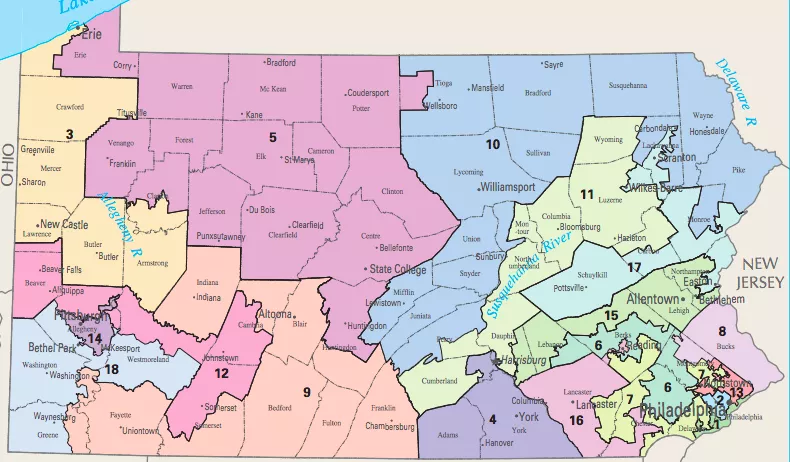
“Goofy Kicking Donald” was but one of the jokes elicited by the erratically drawn Republican map of Pennsylvania’s congressional districts. (Please see the image.) Widely considered one of the nation’s most blatant cases of gerrymandering – whereby electoral districts are distorted to unfairly favor a given political party – it helped Republicans secure 13 of the state’s 18 districts. To put this in context, our state voted Democratic in presidential elections from 1992 until the disaster of 2016.
Now, a successful challenge led by the League of Women Voters to correct this imbalance has prompted a legal and political battle, making frequent headlines in the national news.
Specifically, the League’s June, 2017 suit prompted the Pennsylvania Supreme Court to rule on February 7th that the Republicans’ map violated the state’s Constitution and must be redrawn. Harrisburg was given an ultimatum to either come up with a more equitable map or face a Court-ordered redesign conducted by an outside expert. Harrisburg’s lame response led the Court to adopt a new map, created by Stanford University Professor Nathaniel Persily, a top election law scholar, previously selected by courts for redistricting work in five other states, including North Carolina. (No outsider, Prof. Persily taught at U Penn Law from 2000 to 2007.)
When it comes to the new district for Bucks County, we gained a section of Montgomery County west of Sellersville that typically votes Democratic. According to Nate Cohn’s “The Upshot” in the February 22nd edition of the New York Times, this slight change flips us from “leaned Trump” to “leaned Clinton”, based on the 2016 presidential results. Cohn concludes that Republican Brian Fitzpatrick’s prospects in the 2018 congressional election exemplify “The sort of race that could be decided by the subtle shift ordered Monday.”
In retaliation, the Republicans in Harrisburg filed both a motion to Stay the imposition of the new map with the US Supreme Court, and a suit to overturn it on US Constitutional grounds, with the Federal District Court. The legal action now centers on the request for Stay (filed by the State Speaker of the House and President of the Senate) and the suit (with several Republican Congressmen as plaintiffs).
Both cite the election clause in the US Constitution stating that the “Times, Places and Manner of holding elections for Senators and Representatives shall be prescribed in each State by the Legislature thereof….” and contend that the Court’s action in imposing its plan violates that Clause. The suit quotes voting specialists (including Cohn) that the new PA Court-ordered plan is partisan in its result.
Democrats maintain that the various Republican maps violate the PA state constitution’s requirement for fair elections. Since the State’s Supreme Court gave our Republican-dominated legislature the opportunity to correct this imbalance, and it failed to do so, the Court was within its rights to call upon a widely recognized independent expert to put it right.
In sum, we are caught in a Catch-22. If the Constitution prevails over our state’s doctrine, then the shape of our voting districts – and thus, to a great extent, the electoral outcome — will be set by a legislature seeking to secure its dominance well into perpetuity. Truly responsive government, with elected officials who care about our everyday issues, as well as combating climate change, economic inequality, and discrimination, is founded on fair and open elections.
CALL TO ACTION: Support
Fair Districts PA: Fair Districts promotes legislation to place an independent citizens’ commission in charge of redistricting.
 COMING SOON! View the Lambertville Mayoral Candidates’ Forum in preparation for the June 8th NJ Primary Election. Videos to be posted May 10th.