INDIVISIBLE Lambertville NJ / New Hope PA

Category: Environment

  • PennEast Pipeline Action Alert!

    PennEast Pipeline Action Alert!

    Contributed by Liz Peer, Environmental Action Group

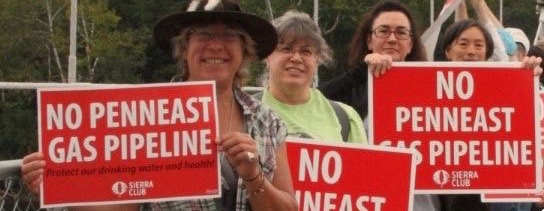
    Comment now on PennEast’s new application to the state of New Jersey here. Comment period is 60 days from August 20, so don’t wait. Some talking points to help you are below: 

    • NJDEP has sufficient information to determine that this pipeline can’t be constructed in a manner that meets the stringent environmental standards required under state law and regulations. NJDEP should deny the permits with prejudice.  This point should be included in all communications!
    • Extensive wildlife surveys conducted by independent biologists documented the significant occurrence of long-tailed salamanders and other sensitive species throughout the proposed route. These reports were submitted to the State Natural Heritage Database.  NJDEP should rely on these data, which show that PennEast would threaten protected species of wildlife, rather than PennEast’s incomplete surveys, in order to ascertain the true impact the pipeline would have.
    • PennEast would cut through Baldpate Mountain in Mercer County, an important bird area supporting numerous migrating and breeding species, including 28 ranked by the American Bird Conservancy as birds of conservation concern. PennEast would cross or come within 100 feet of four important bird areas, posing a threat to irreplaceable wildlife.
    • Research has found that open-cut, isolated, and Horizontal Directional Drilling (HDD) stream-crossing methods for pipeline construction have damaged channel morphology, water quality, and aquatic life, and habitats.  Any of these stream crossing methods will result in unacceptable impacts to protected waterways and wildlife.
    • According to industry sources, Horizontal Directional Drilling crossings (HDDs) cause inadvertent returns or frack outs 50% of the time. It is a coin toss whether an HDD will fail or not. The Mariner East 2 project in Pennsylvania clearly demonstrates the extensive environmental damage these inadvertent returns can cause to wells and waterways. As of February 2019, there were about 240 inadvertent returns of drilling fluid to land and water along the Mariner East 2 route, and the Pennsylvania Department of Environmental Protection had issued 94 notices of permit violations.  
    • By adding impervious surface to local watersheds, construction of the PennEast pipeline would exacerbate sediment-loading in the D&R Canal – threatening a drinking water source for millions of central New Jersey residents.
    • Researchers have identified the potential for arsenic contamination in some areas along the PennEast pipeline route. The geology in areas along this route includes rock that is rich in arsenic, and disturbance of these areas could release arsenic into groundwater in an area of the state that already has high levels of arsenic in groundwater.
    • Nearly 800 drinking water wells in NJ and PA are within 800 feet of the proposed pipeline route and are at risk. Given that numerous wells were contaminated as a result of HDD inadvertent returns from Mariner East 2 construction, there is no reason to believe PennEast would produce a different result.
    • Construction of PennEast poses a significant risk to the Swan Creek Dam, which if ruptured, would result in catastrophic flooding in Lambertville.
    • PennEast would cut through over 4,300 acres of land preserved by the state, counties, municipalities, and non-profit organizations. Taxpayer dollars have been invested in these lands to protect water, natural, historic, and agricultural resources for the benefit of the residents of New Jersey. NJDEP should not allow a pipeline that would threaten this investment.  
    • A study by the Goodman Group found that PennEast overestimated by two thirds the number of jobs that would result from construction of the pipeline, and that only 10 ongoing jobs would be created in New Jersey. According to The Cadmus Group report, all forms of renewable energy – such as wind and solar – or energy conservation projects would be expected to create more jobs than PennEast – from 2,744 to 13,719 additional jobs for the same level of investment.
    • The NJ Rate Counsel found no public need for PennEast, called it “unfair to ratepayers” and concluded that the project is driven by PennEast’s opportunity to earn a 14% rate of return that would be like “winning the lottery” for the project sponsors.
  • Talking about climate change

    Contributed by Liza Watson.

    Two ILNH members attended a Stanford political psychology professor’s talk on the effects of persuasive messages on attitudes toward climate change. He has been studying this area for a long time – bottom line is that attitudes are very hard to affect, and about 80% of the adult population has the view that humans have played a role in causing climate change. If you run into a climate change denier, here are some tips:

    Say this: If you asked a room of 10 Americans about global warming, eight would say they accept the knowledge that it is happening.

    Not this: You just have to “believe” in climate change.

    Say this: Most of your neighbors and community members have the view that our planet is warming and that we humans have played a role in this change.

    Not this: Be a rebel, say you accept scientific evidence.

    Say this: I’m happy to learn that 74% of Americans prefer preparation for changes that will come with our changing climate instead of waiting to see what we have to deal with.

    Not this: Some people are ostriches – they are going to see their beach homes destroyed and they won’t get their head out of the sand.

  • ILNH FYI – Your Activists in Action

    ILNH FYI – Your Activists in Action

    Environment Action Group: ILNH joined several other environmental groups to sign a letter to the governors of Delaware, New Jersey, New York, and Pennsylvania calling for stringent review of the PennEast Pipeline project, saying that the application for PennEast to the Delaware River Basin Commission (DRBC) do not demonstrate that the pipeline meets the requirements of law. Subsequently, Governor Phil Murphy announced his support for a full fracking ban in the Delaware River Basin and issued a letter to the DRBC expressing his position that proposed rules should be amended to ban all fracking activity, including the import, treatment, and discharge of fracking wastewater.

    “The ILNH Environment Team has always supported a complete fracking ban in the Delaware River Basin and will continue to work alongside activists, NGO’s and our state to ensure our river basin is untouched by the environmental and public health dangers of fracking,” said Liz Peer, ILNH Environment team lead. “We thank Governor Murphy for his leadership on this important matter.”

    During our first Facebook Live meeting back in January we talked about the new SpringBoard Meetings that are being planned for deeper dive education and activism on specific topics. We’re looking forward to the first of the series with Civil Rights taking the lead on Mass Incarceration. Look for more information about the expert, date and location on the ILNH Facebook page. And BTW, if you’re interested in being a Coordinator or Activator for a particular topic, see Sarah Gold or Maddy Berlin.

    Meet the ILNH Board: Did you know that Indivisible Lambertville/New Hope has a Board in addition to our Operating Team? The Board oversees the ILNH activities to ensure that they fall within our vision, mission and values. Less sexy, but more importantly, the board is accountable for making sure that activities stay within the scope of a 501(c)(4) organization so that we maintain our non-profit status. In addition, the board is responsible for certain state and federal filings, and carefully tracks finances, etc. They also work with professionals to ensure accountability for legal requirements and responsibilities pertaining to our non-profit status.  Current Board members include Susan Shapiro, Mark Zenkus, Elaine Clisham, Elycia Lerman, Karen Mitchell and Cindi Sternfeld. Positions on the Board are held for two years, and can be served in succession

    Census 2020: Ensuring accuracy – The Complete Count Commission will hold the second Public Meeting of the Census 2020 New Jersey on Wednesday, February 20th at the Passaic County Community College’s Main Campus Auditorium in Paterson. The goal of the Complete Count Commission is to encourage full participation in the census to ensure an accurate and complete count of New Jersey’s population. An accurate count is critical to how we are represented in government and is directly related to the amount of federal funding that will flow into New Jersey annually. We want to make sure that we receive our fair share.

    An important core component of this process will involve the organizing and asking the help of advocacy groups and everyday people a sustained campaign within our communities aimed at attaining the highest possible Census response rate. This is an All New Jersey project and its success will very much be determined by on the ground community advocacy and participation.

    If you plan to attend, are interested in attending, or would like to provide testimony, please respond at this link: https://www.state.nj.us/state/njcounts-meeting-rsvp.shtml

  • Farms and No Food? – SNAP and the 2018 Farm Bill

    What is the Farm Bill?
    The farm bill is an “omnibus” piece of legislation that combines funding for a lot of different programs into one piece of legislation. The first farm bill was passed in response to the dust bowl in the 1930s and was meant to increase farm incomes and encourage conservation. Since then, the farm bill has grown in scope to include other programs, and would reauthorize various commodity, trade, rural development, agricultural research, and food and nutrition programs. Under the current farm law, program authorizations will expire Sept. 30 or the end of the applicable crop year.
    Historically, the farm bill has passed with considerable bipartisan support, but in recent years it has become more contentious as Republicans have ramped up their attempts to enact sweeping changes to Supplemental Nutrition Assistance Program or SNAP that may make it harder for people struggling to make ends meet to get food assistance.
    Current Status of the 2018 Farm Bill
    In May, the House version of the Farm Bill was defeated when 30 Republicans voted with Democrats to defeat the bill. On June 21, the House passed the bill by a narrow margin – 213-211. Democrats were unanimous in their opposition to the bill over severe cuts, new work requirements and expanded penalties for food stamp recipients. Twenty Republicans joined with Democrats in opposing the bill, but eight Freedom Caucus members flipped their votes from May and voted in favor of the bill.
    The Senate version of the bill passed out of the Agriculture Committee on June 13, with consideration by the full chamber expected before July 4. The Center for Budget and Policy Priorities (CBPP), a nonpartisan research and policy institute with a focus on reducing poverty and inequality, gives the Senate version a thumbs up for its handling of SNAP. According to the CBPP, the bill included a bipartisan nutrition title that would reauthorize the Supplemental Nutrition Assistance Program (SNAP, formerly food stamps) and improve SNAP’s program integrity and operations. The bill also would expand the 2014 farm bill’s pilot program to test promising approaches to job training and other employment-related activities for SNAP participants and would make targeted investments in SNAP that help seniors and people with disabilities, as well as Indian Tribes. And, the bill would make changes to and increase funding for certain grant programs outside of SNAP.[1]
    What’s Next and the Impact to SNAP
    While the Senate’s version of the bill may prove more palatable, the two bills ultimately need to be reconciled and currently there are wide differences – especially to the SNAP program. The House version seeks tighter work requirements for eligibility, increasing the work requirement age to 59 (from 49) and increasing penalties for those that fail to prove they’ve met the 20 hours per week work requirement with elimination of benefits for one year and up to three years. States also lose the flexibility to make the program easier for participants to use.
    This is part of a larger push to radically transform federal assistance programs. Since Trump took office, Republicans in Congress and in the administration have been adding or tightening work requirements for programs like SNAP and Medicaid. These restrictions don’t do anything to help the people served by these programs, but they do result in more people falling into poverty as the protections they rely on are stripped away.
    House Republicans have been playing a cynical game in selling their partisan farm bill. They say it has no SNAP cuts. Don’t be fooled: the House Agriculture Committee farm bill would cut or take away SNAP benefits from 1.5-2 million people, and we expect that amount will be much higher if it became law. Thousands of children would also risk losing their enrollment in free and reduced-price school meal programs.
    It’s important to stay tuned to what’s happening as it unfolds on a near daily basis. If a final bill isn’t authorized before the deadline of September 30, most likely there will be an interim extension.
    It’s also important to note that this enormous bill also has ramifications for renewable energy programs, the environment, small local farms and markets, and much more.
    For more information, read the CBPP’s report on the Senate version of the bill here, and read the organization’s statement on the detrimental impact of the House bill passed June 21 here.
    Call to Action:
    Leonard Lance and Brian Fitzpatrick voted against the House bill, breaking with party lines. The Senate still needs to call a floor vote, so determine your Senators’ stance on the Senate version, which is generally agreed to be more supportive of SNAP. Watch carefully as the bill goes into reconciliation – and demand that the final bill expand support for SNAP, lighten work requirements as well as provide flexibility for states to re-assess or waive work requirements in times of hardship or low job availability. Finally, any job training programs should be effective and applicable to employment opportunities that are available or can be made available within a reasonable geographic area of a recipient’s residence, and not just drain dollars from the program while for an unwieldy, bureaucratic ‘jobs’ program with an ineffective outcome.
  • Hot Topic In Our Own Back Yard: FERC Approves PennEast Pipeline

    Hot Topic In Our Own Back Yard: FERC Approves PennEast Pipeline

    On Friday, Jan. 19, the Federal Energy Regulatory Commission gave its approval to the PennEast pipeline. It’s a big setback, but the pipeline can’t be built without approval from the New Jersey Department of Environmental Protection. New Jersey already rejected an application from the PennEast Pipeline Company once. If enough of us keep raising our voices, we can show the Department of Environmental Protection that we don’t want a huge pipeline destroying protected open space and some of our cleanest waterways.
    What are you gonna do?
    “The fight’s quixotic,” my friends asserted. “It’s foolish to think you can make a difference.”
    “But if this pipeline gets built our neighbors will lose their land and our town could be flooded!!” I persisted.
    “All the same, Michael, you can’t stop a pipeline!”
    “I think it’s a cause worth fighting for, don’t you?”
    Thus ran the debate when I joined the fight to stop the PennEast pipeline. It was the first time I’d gotten involved in a political cause.
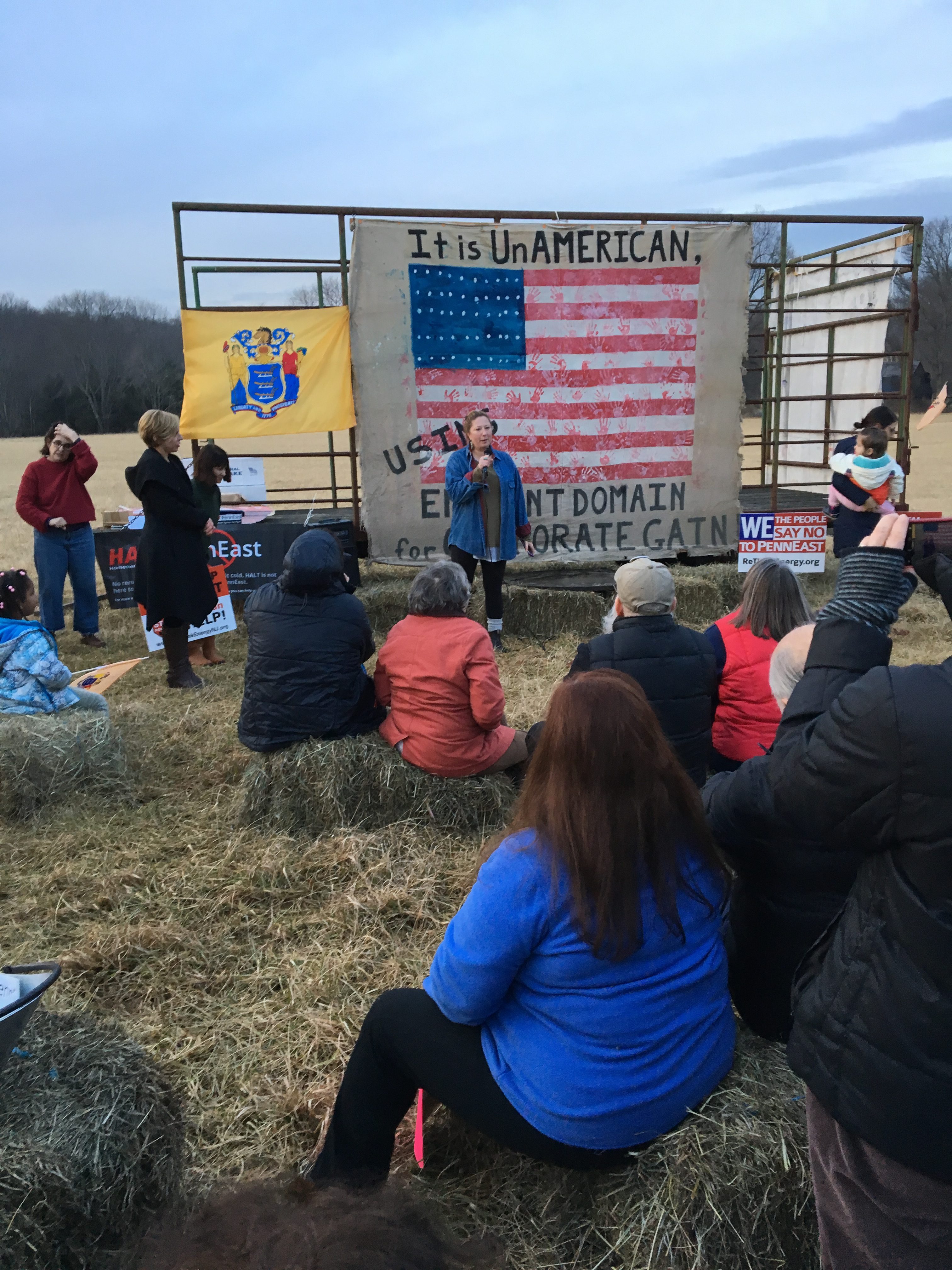
    My involvement started with a conversation, where I learned that the pipeline’s planned route goes right by Lambertville City’s reservoir, which has a dam rated high risk and is surrounded by granite, which will require blasting for the pipeline. The prospect of our city being flooded got my attention. I discovered that our neighbors in Hunterdon and Mercer counties could have their land taken away and would be living in the pipeline’s blast zone. I joined Homeowners Against Land Takeaway (HALT) and its Board of Trustees, questioned officials and candidates running for office, and do my best to keep the community informed.
    As I got involved in the fight, I came to understand some ugly things. The bad news is:
    Lesson 1: Five companies are investing in PennEast—New Jersey Resources, South Jersey Industries, Southern Company Gas, Spectra Energy Partners, and UGI Energy Services. They provide natural gas to customers and all proclaim the purpose of the pipeline is to provide low-cost gas to New Jersey residents. However, the natural gas market is flat. Their challenge is: How can we create a growth story for Wall Street to keep growing our stock prices? The answer? Build a pipeline! Why? Because the federal government, through the Federal Energy Regulatory Commission (FERC), guarantees a 14 percent profit to companies that build pipelines. When was the last time you were guaranteed a 14 percent profit?
    The Securities and Exchange Commission (SEC) filings of all five companies investing in PennEast state that New Jersey has enough natural gas to satisfy market needs through existing pipelines. The state Division of Rate Counsel, the agency that monitors natural gas supply and demand, concludes the same. That federally guaranteed 14 percent profit and its expected impact on stock prices is the sole reason for the PennEast pipeline. And the consequences for the little guy in cold cash? That 14 percent big corporate profit will come out of the pockets of ratepayers—you and me. So much for the myth of low-cost gas for New Jersey residents!
    Lesson 2: In grade school we’re taught that we’re a nation ruled by laws, not men. This, however, is only a half-truth. Under federal law, FERC guarantees a 14 percent profit, conditionally approves incomplete environmental applications, and enables eminent domain, allowing the seizure of citizens’ land. FERC enforces the law, as it interprets it. In the case of PennEast, FERC’s interpretation includes approving an environmental application so incomplete that it has been rejected by the U.S. Army Corps of Engineers and the state Department of Environmental Protection (NJ DEP). Nevertheless, the NJ DEP can use the federal Clean Water Act to stop pipelines. But here comes the hitch: NJ DEP can only stop a pipeline with the governor’s approval. Enforcement, in practice, is the governor’s decision.
    And the good news? New Jersey has a new governor, Phil Murphy. Murphy stated on videotape in Lambertville last year that the PennEast pipeline makes no sense economically or environmentally, and should be stopped. Suddenly the “quixotic” fight looks winnable!
    Who’s writing and enforcing our laws? Any law that enables a federal agency that (at best case) is influenced by the industry it regulates, or (at worst case) is controlled by that very industry is suspect. Yet this worst-case scenario is exactly what we have in FERC. The Clean Water Act is meant to protect our water and yet one governor can ignore it, and the next can chose to enforce it or not—it’s up to the governor.
    We must enforce existing laws that protect us and our children, and fight to pass new laws that benefit future generations. This is what we should stand for with renewed vigilance. The level of vigilance for any of us—the effort we put into educating ourselves, becoming involved in our communities, and voting—is a matter of temperament.
    Maya Van Rossum, the Delaware Riverkeeper, and her organization, the Delaware Riverkeeper Network, have vigilantly worked to protect the Delaware River for many years, fighting the negative impacts of state and federal policies on the health of the Delaware River and its surrounding communities.
    Maya has recently proposed a Green Amendment to the New Jersey constitution (see her inspiring site forthegenerations.org). Now, more than ever, with one of our major political parties denying climate change, we need to join her and other like-minded citizens to ensure our right to a clean environment, clean air, and clean water. If we don’t write and pass the laws we want, the fossil fuel and chemical companies will write the laws they want—laws that guarantee 14 percent profits and allow corporations to seize or pollute our lands.
    In times like these, when the White House talks about “alternate facts” and the influence of dark money permeates our lives, it’s easy to feel discouraged, depressed, and alone. I, for one, have discovered that it helps a great deal to focus on a cause and join forces with others, like HALT and the Delaware Riverkeeper Network, that are fighting to protect our rights and improve our lives.
    “What are you gonna do?” can be a resigned expression we use to evoke a sense of powerlessness, or a question we ask ourselves to determine how we can help to make our community a better place. Which will it be for you?
    Even if you’re not an active fighter, you can—and should— be an active voter. Important primaries are coming up in New Jersey in June, and elections will be held in November. If you aren’t inclined to get out and fight, get out and vote. If you are inclined to fight, there is plenty of work to do and organizations for every candidate—Indivisible, the Delaware Riverkeeper Network, and other groups support causes and candidates.
    The fossil fuel industry can fund candidates, but it cannot win if we vote its candidates out. Voting is the one thing all citizens can do. By voting for candidates that share our values, the next time an unneeded pipeline, or some other threat to the environment, comes our way we’ll have strong laws to prevent catastrophe and elected officials who’ll enforce those laws strictly in order to protect our land, our future and us.