INDIVISIBLE Lambertville NJ / New Hope PA

Category: Criminal Justice

  • Voting Rights Restored to 80,000 in New Jersey

    Voting Rights Restored to 80,000 in New Jersey

    Contributed by Amara Willey.

    Here’s some welcome news for our democracy…

    December marked a victory for former felons who have served their time: they received the right to vote again in New Jersey. Gov. Phil Murphy signed a law that restores voting rights to 82,000 residents who are on probation or parole in the state. That still leaves disenfranchised about 20,000 felons who are still serving time.

    The law will take effect in March in plenty of time for those affected to register to vote before the primary election. Why this is particularly good news is that a large percentage of our prison population is African American or Hispanic. Likely this is not only a victory for our democratic ideals but will also give the vote back to a number of people of color who had lost the vote when they were convicted.

    “For centuries, the black community has been disproportionately affected by this voting prohibition and onerous expungement process. I am relieved that these discriminatory barriers are finally being eliminated in New Jersey,” said Lt. Gov. Sheila Oliver (D), who oversees the Department of Community Affairs, in an article in The Hill last month.

    Since New Jersey is a blue state, adding 80,000 voters of color probably won’t make much difference in the outcome of the national elections, though it could change the outcome of local elections in more right-leaning areas. This initiative is the latest in a national push to restore voting rights to former felons. Last year, Florida voters amended their state constitution to allow former felons to vote. Nevada and Louisiana legislatures passed similar bills this year.

    Also in December, Kentucky’s Democratic Governor Andy Beshear gave voting rights back to those who had been released from prison by executive order. Iowa governor Kim Reynolds, a Republican, may follow suit.

    There is no indication that restricting voting rights to convicted felons deters further crime. Quite the opposite seems to be true, that the more former criminals feel connected to the community, the lower the recidivism rate.

    “In a democracy, everyone should have a voice,” the Philadelphia Inquirer quoted Henal Patel, a lawyer at the Newark-based New Jersey Institute for Social Justice, a nonprofit that led the voting-rights restoration campaign. “Tying the criminal justice system to the electorate makes no sense, and, if anything, undermines the purpose of why we have a criminal justice system.”

    Gov. Murphy signed a second related bill in December that would allow former felons to have their record expunged if they haven’t committed another crime in 10 years. That law doesn’t include more egregious felonies, but it automatically seals records of low-level marijuana convictions after sentences have been served.

    While this was a victory for both democratic principles and minority rights, the ACLU remains committed to restoring voting rights to those still in prison, according to The Philadelphia Inquirer.

    Sources:

    https://thehill.com/homenews/state-watch/475101-new-jersey-governor-signs-voting-rights-restoration-bill

    https://www.inquirer.com/politics/new-jersey/nj-felon-voting-rights-restoration-probation-parole-20191212.html

  • ILNH Civil Rights Group Movie Screening: ’13th’

    Contributed by Lisa Bergson.

    The ILNH Civil Rights team invites you to join us at the Lambertville Acme Screening Room (S. Union Street) on Sunday, June 30, from 1:00 to 3:00 p.m. for the “13th”, the powerful documentary on mass incarceration directed by Ava DuVernay.

    “We’re giving you 150 years of racism in 100 minutes,” DuVernay told The Atlantic.  “This film was 150 years in the making.”

    “13th” will be followed by commentary from ILNH member and Lambertville resident Prof. Ralph Young, author of Dissent: The History of an American Idea.  

    Notably, DuVernay also directed “Selma” and the upcoming four-part HBO series, “When They See Us”, about the highly sensationalized, false conviction of five African-American teenagers for the 1989 assault and rape of the Central Park jogger.  Her filming took place at the same time that Justice Brett Kavanaugh’s nomination to the Supreme Court was under scrutiny, leading DuVernay to wonder, “What kinds of boys truly get to be young and carefree, and what others are indicted on sight?”

    From her earliest work as a filmmaker, DuVernay has delved deep into the issue of mass incarceration, the virtual enslavement of African-American males, under the aegis of the 13th Amendment (italics ours): “Neither slavery nor involuntary servitude, except as a punishment for crime whereof the party shall have been duly convicted, shall exist within the United States.” Of the impact her film achieves, DuVernay states, “Look at this picture.  Look where we are. After you see ’13th’, silence is consent.”

    Sources:

    • “Let the Record Show”, Mattie Kahn, Vogue, p.74, June, 2019.
    • https://www.theatlantic.com/entertainment/archive/2016/10/ava-duvernay-13th-netflix/503075/
  • Springboard to Criminal (In)Justice – Bearing Witness

    Springboard to Criminal (In)Justice – Bearing Witness

    Contributed by Lisa Bergson.

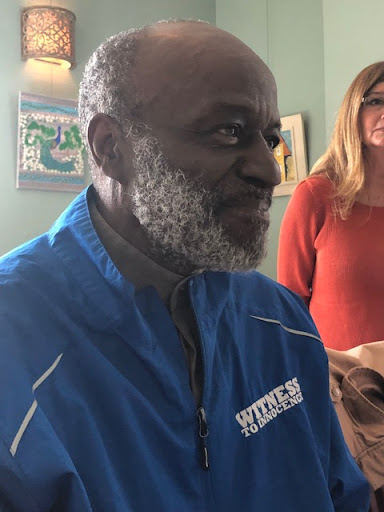
    Shujaa Graham stops short at the sight of the solitary-cell 6’ X 9’ dimensions measured with blue tape on the linoleum floor of the Acme Screening Room lobby in Lambertville, N.J. It’s the afternoon of “Shatter the Silence: Criminal (In)Justice,” a program organized by Indivisible Lambertville/New Hope’s Civil Rights Action Team, where Graham is scheduled to speak.  As attendees file by, many glancing in horror at the cell’s cramped quarters, he steps inside the bounds of a world he knows all too well. Exonerated after five years spent in isolated confinement on San Quentin’s death row, Graham has dedicated himself to Witness to Innocence, a Philadelphia-based organization led primarily by exonorees, seeking an end to the barbarism of the death penalty.

    Out for close to 37 years, Graham stands at the foot of the taped, narrow rectangle labelled “bed,” his eyes far away as he points about, like a tour guide in hell, “It was just like this, only no window, and I don’t remember no desk.  Just half-hour a day to get out for a shower.”

    The United Nations equates more than 15 days in solitary to torture.  But, right here in New Jersey, we rank third in the nation, just behind Nevada and Massachusetts, when it comes to women inmates stuffed in isolated confinement.1 At Edna Mahan, the state’s only prison for women located in Clinton, NJ, the average number of days individuals are so-called “segregated” is 338.

    Any worries the event’s organizers had about turnout on this sunny spring afternoon are dispelled by the over-capacity turnout of 72 folks who showed up to hear Graham and the director of Trenton’s Campaign to End the New Jim Crow (CENJC), Patrick Hall. Patrick’s organization is part of a nationwide movement, inspired by Michelle Alexander’s award-winning book, The New Jim Crow, exposing our racist system of mass incarceration and its destructive impact on minority communities, along with the exploitation of prison labor by many of our country’s biggest businesses, including Walmart, Procter & Gamble, and MacDonald’s, according to Hall.

     “Mass incarceration is about money,” Hall tells the gathering.  “Mass incarceration is an extreme rate of imprisonment. They keep locking people up. Crime is going down.  But, mass incarceration is a business.” Not only are private prisons a big and burgeoning business,2 but their expansion is becoming an economic bedrock of the often poor, white, and rural communities where they are located.3 (Any one listening to National Public Radio during the recent federal government shutdown would have been riveted by the story about unpaid prison guards working in a correctional facility in Oakdale, Louisiana, and what those jobs meant to their community.)

     “Private prisons have contracts, and the cities and counties are getting paid for them too.  They have to keep them filled,” Hall says, matter of fact.

    Although their paths took widely divergent trajectories, both Hall and Graham share a childhood marked by loss and instability.  “Between the first and third grade, I went to 11 different schools,” recalls Patrick, noting that his father was an alcoholic and the family “moved around a lot.” Seeking work, Graham’s parents left their boys with their grandmother when they moved to Los Angeles. Not long after the family was reunited in the depressed South Central neighborhood, Graham, then 12, got caught up in the gang world. “That’s where my troubles begin,” he laments, adding: “They were recycling me in and out of juvenile hall.”

    At 18, he wound up in Soledad State Prison, where his life was forever changed by an encounter with an older inmate who encouraged him to improve his reading skills and learn history “to understand how you got here.”  As Graham recounts: “I started reading right then, and I renounced the gangs. We started organizing.” After moving to another facility in Stockton, Graham got caught up in a prison uprising:

    “On September 27, 1973, a human being was killed. I would have make them kill me that day if I had a clue of what I would face for the next five years.  San Quentin had the gas chamber, and that’s where I went.”

    Framed for his activism, Graham’s first trial ended with a hung jury.  His next two trials were overturned, based on the systematic selection of all white juries. “I never contemplated suicide, but there were nights when I went to bed, it would be OK if I didn’t wake up.” By the fourth trial, Graham was given the chance to help select the jurors, surprising his lawyers by picking a white banker. (“I could tell he was intelligent.”)  He goes on, “The jury deliberated for four days. I was up in a cell, just like the one you see out there. I was pacing.”

    Such a plight is not unlike that of many on Pennsylvania’s death row.  Pennsylvania is the one state in the nation that does not provide funding for the defense of poor defendants, who comprise over 80% of those accused. It cedes this obligation to the counties, leading to a big disparity – in fact, the largest in the U.S. – of capital sentences from county-to-county. The result is a haphazard and inconsistent patchwork of attorney appointment protocols, literally playing Russian Roulette with defendants’ lives.4

    In the Keystone State, some one-third of the convictions on our death row have been overturned as a result of poor lawyering.  Execution of those denied fair and proper representation is tantamount to state-sponsored murder. For this reason, in February, the American Civil Liberties Union and the ACLU of Pennsylvania filed a friend-of-the court brief in February, asking the state Supreme Court to hold PA’s capital punishment system in violation of the PA constitution!

    “I’m tough on crime,” says Graham, by now a grandfather of five. “But, I am against the death penalty.  We don’t need more victims.”

    “I never wanted no one to have to experience what I had experienced,” Graham intones. “Every day, I wake up and think about where I would be if California had its way.”  After offering a standing ovation in tribute, audience members in tears come to hug him, offering their support, some sharing their stories of incarceration.  Graham is crying too, but not for himself. May his tears for those men and women still on death row, may they not be in vain.

    Calls to Action:

    • Curb Solitary in NJ: Tell your New Jersey representatives to support the Isolated Confinement Restriction Act (bills A-314 and S-3261, Assembly and Senate respectively). The bills limit solitary to 15 days at a stretch and ban it for pregnant women, inmates 55 and older, those 21 and younger, as well as folks suffering from mental illness and disabilities. It can only be used on those posing a “serious and immediate risk of harm to self or others” and after all less restrictive measures fail.
    • Stand up for Witness to Innocence: Learn about and support this vital and inspiring exoneree-driven organization: Witnesstoinnocence.org
    • Link arms with our Trenton-based Campaign to End the New Jim Crow: endnewjimcrownj.org
    • Support the PA ACLU: “Defending Liberty Where It Began!”
    • JOIN US! Join the ILNH Civil Rights Action Team as we continue to educate ourselves and our communities about the plight of our nation’s most oppressed populations, promoting sweeping and powerful change for the better.

    Footnotes and sources:

    1. “Reforming Restrictive Housing: The 2018 ASCA-Liman Nationwide Survey of Time-in-Cell”, The Association of State Correctional Administrators, The Liman Center for Public Interest Law at Yale Law School, ASCA-Liman Restrictive Housing 2018 revised September 25 2018, October 2018, pages 14-15.
    2. Michelle Alexander, The New Jim Crow, Mass Incarceration in the Age of Colorblindness (New York: The New Press, 2012), 230.
    3. Ibid., 232.
    4. ACLUPA.Org/News, “ACLU Urges PA”
  • Redefining Juvenile Justice

    Contributed by Amara Willey.

    Summary:

    Race discrepancies in juvenile detention could be narrowed by handling misdemeanors as civil rather than criminal cases. More resources towards prevention, education, and treatment would also narrow the race gap, according to The Sentencing Project, a criminal justice research and advocacy organization.

    ___________

    According to Department of Justice data, black juveniles are three times more likely to be incarcerated than Latinos, and six times more likely to be incarcerated than whites, nationwide. In New Jersey, for every Caucasian juvenile inmate, there are five Hispanic and 30 African-American inmates, according to the Sentencing Project. In Pennsylvania, the numbers are one Caucasian to nine African-American and three Hispanic juvenile inmates.

    Another startling statistic: The vast majority of criminal cases, more than 13 million annually, are misdemeanors.

    In many places, misdemeanors are over-enforced in low income neighborhoods, leading to detention, fines and criminal records that can hurt access to education, housing and jobs. On the other side of the coin, in many communities, including those of color, residents demand enforcement of misdemeanors. No one wants to live in a neighborhood overrun by crime and disorder.

    As a way to address racial disparity in the justice system, The Sentencing Project recommends alternative sentencing options to incarceration, investing in high school completion, encouraging states to adopt racial impact legislation, supporting drug treatment and prevention, state and local racial equity goals, and examining policy and practice decisions for undue racial impact.

    The New York Police Department (NYPD) is working towards one answer of how to address this issue. The NYPD has reduced misdemeanor crime by 36 percent since 2010, by rerouting minor crimes from the criminal to civil courts. In New York, police and prosecutors along with several non-profit organizations are offering those arrested for misdemeanor crimes another alternative to court. Project Reset allows those charged with shoplifting and trespassing the opportunity to complete a restorative-justice circle or a class with a local artist focusing on positive self-expression to leave the process without a criminal record. A recent study of the program showed that cases were resolved 72 percent faster and participants had fewer new arrests compared to those who experienced conventional prosecution.

    “New York City offers the outlines of a model that takes seriously the kinds of misbehavior that undermines community quality of life, shrinks the footprint of the justice system and judiciously uses the power of the state to help people improve their lives,” says Greg Berman, the Director of the Center for Court Innovation. “Police should be encouraged to use their discretion to issue warnings and not routinely make arrests when they encounter people engaged in minor rule-breaking. Prosecutors and judges should be provided with alternatives to prosecution and incarceration so that short-term jail sentences can effectively be eliminated. And everyone in the system should be given the training and resources they need to work in a way that is free of bias and that honors the fundamental dignity and humanity of those they encounter.

    A 2016 Sentencing Project report found that New Jersey was the most racially disparate state in terms of incarceration, and Pennsylvania was 7th. The study used data collected in 2014. The study found that Pennsylvania had 8.9 African-American people incarcerated for every white person in 2014. New Jersey had a disparity of 12.2 to one. Nationally, the rate is about 5 to one, according to the study. (Pennsylvania had the third highest and New Jersey 10th for ethnic disparity between Hispanic and white persons incarcerated.)

    While one of the worst states for racial disparity, New Jersey does have a 2016 racial and ethnic impact law to study the problem and give data to New Jersey legislators to try to ameliorate the system. In October of 2018, Gov. Phil Murphy created a task force by Executive Order for the Continued Transformation of Youth Justice. The task force will focus on reducing recidivism and make recommendations for improving the state’s juvenile justice system, including addressing racial disparities.

    In 2017, the Pennsylvania Commission on Crime and Delinquency recommended a comprehensive strategy for high-risk youth. Though not directed specifically at juveniles, in April of 2018, Gov. Tom Wolf called for eight key criminal justice reforms, including clean slate legislation and fair sentencing. “We need to do the work to make our criminal justice system fairer, more equitable and more focused on rehabilitation,” Gov. Wolf said.

    Sources:

  • With the First Step in Question, What’s Next?

    Contributed by Amara Willey.

    Status of federal criminal justice reform legislation

    Summary:

    The December criminal justice reform law called the First Step Act has many benefits for both adult and juvenile offenders. Although the bill received bipartisan support and was touted as a win for Trump, his mid-March budget does not include enough funding for it. Further, federal expansion of background checks for job applicants undermines the letter of the law. However, expansion of criminal justice reform will undoubtedly be a part of the 2020 election, with the introduction of Sen. Cory Booker’s Next Step bill.

    The First Step Act, signed into law in December 2018, provides reforms for federal prisons and sentencing, more education and job training, and rehabilitative programs for inmates. This bipartisan law, which seemed to have the support of the President, has a number of challenges facing it.

    Funding the law requires $75 million per year for five years. As of this writing, how the law will get this funding is not clear. President Trump’s mid-March budget draft underfunded the program by more than $60 million for the first year. The Justice Department could choose to reallocate funds or use savings from the early release of prisoners to help fund the program to help make up the shortfall. Further, it is unlikely that the draft will pass Congress.

    Prisoners slated to be released on good behavior under the First Step Act may have to wait as much as seven months for their release while the programs in the Act are being implemented. The Federal Bureau of Prisons said in a statement to Mother Jones: “We know that inmates and their families are particularly interested in the changes regarding good conduct time, but, it is not effective immediately, nor is it applicable to all inmates.”

    One of the most promising programs, Juvenile Justice and Delinquency Prevention which revamps how states treat juvenile offenders, was unmentioned in President Trump’s State of the Union address. Under the new law, states are required to collect data on racial disparities in the juvenile system and develop strategies for addressing inequality. Failure to comply will affect federal funding allocations to those states for the purpose of data collection. The law mitigates sentencing for juveniles, prohibits the holding of juveniles in adult facilities, and prevents states from detaining juveniles for more than seven days for truancy or running away from home.

    “This legislation strengthens each of the core protections for children in the juvenile justice system,” Rep. Bobby Scott (D) of Virginia said in a statement when the bill passed the House in December. “It ensures children are treated separately — both in approach and location — than adult offenders; it shifts the focus from punishing young people to supporting them through education and programming; and it puts a spotlight on the racial disparities in our juvenile justice system.”

    On the other end of the spectrum, the Federal government seems to be moving towards expanding background checks for federal job applicants, which is exactly opposite to the spirit of the new law. The criminal justice journalism non-profit organization, The Marshall Project, reported that the US Office of Personnel Management wants to expand criminal background checks for applicants of federal jobs and contracting positions, requiring them to disclose not only if they’ve served prison sentences, but also if they’ve spent time in jail or gone through diversion programs. The ACLU believes this will interfere with state and local courts’ choice to utilize diversion programs as an alternative. It’s just a proposal for now, and the public has until April 23 to submit comments on the idea at www.regulations.gov.

    In early March, NJ Senator and presidential candidate, Cory Booker, who was instrumental in the passage of the First Step Act, introduced the Next Step criminal justice reform bill. The bill addresses sentencing, drug-related convictions, expungement, racial profiling, voter rights reinstatement and police racial bias training, among others. One of the most promising parts of the bill is reintegration and early release, which could provide significant cost reduction to the prison system. With bipartisan support for criminal justice reform, this is bound to be a hot topic for the 2020 presidential election.

    “The Next Step Act is the most comprehensive, ambitious criminal justice bill to be introduced in Congress in a generation. It would reduce harsh mandatory minimums for nonviolent drug offenses, while also eliminating the disparity between crack and powder cocaine sentences,” said Booker in a Washington Post Op-Ed. “It would also prohibit federal employers and contractors from asking job applicants about their criminal history until the final stages of the interview process; improve the ability of those behind bars to stay in touch with loved ones; provide better training for law enforcement officers in implicit racial bias, de-escalation and use-of-force; reinstate voting rights for formerly incarcerated individuals; and end the federal prohibition on marijuana.

    The Next Step bill includes the following:

    • Prohibiting federal employers and contractors from asking about criminal records
    • Granting licenses for certain job categories, such as hairdresser and taxi driver, to those with records
    • Restoring voting rights to former inmates
    • Reducing mandatory minimum sentences for non-violent drug-related crimes
    • Training for law enforcement on racial bias
    • The Marijuana Justice Act

    Sources:

    https://www.motherjones.com/crime-justice/2019/03/trump-budget-jared-kushner-first-step-act-underfunded/

    https://www.themarshallproject.org/2019/03/05/would-expanded-criminal-background-checks-hurt-federal-job-applicants

    https://www.governing.com/topics/public-justice-safety/gov-trump-sotu-juvenile-criminal-justice-reform-states.html

    https://www.nj.com/politics/2019/03/here-is-bookers-next-effort-to-change-the-criminal-justice-system.html