INDIVISIBLE Lambertville NJ / New Hope PA

Category: Constitutional Rights

  • ILNH Civil Rights Group Movie Screening: ’13th’

    Contributed by Lisa Bergson.

    The ILNH Civil Rights team invites you to join us at the Lambertville Acme Screening Room (S. Union Street) on Sunday, June 30, from 1:00 to 3:00 p.m. for the “13th”, the powerful documentary on mass incarceration directed by Ava DuVernay.

    “We’re giving you 150 years of racism in 100 minutes,” DuVernay told The Atlantic.  “This film was 150 years in the making.”

    “13th” will be followed by commentary from ILNH member and Lambertville resident Prof. Ralph Young, author of Dissent: The History of an American Idea.  

    Notably, DuVernay also directed “Selma” and the upcoming four-part HBO series, “When They See Us”, about the highly sensationalized, false conviction of five African-American teenagers for the 1989 assault and rape of the Central Park jogger.  Her filming took place at the same time that Justice Brett Kavanaugh’s nomination to the Supreme Court was under scrutiny, leading DuVernay to wonder, “What kinds of boys truly get to be young and carefree, and what others are indicted on sight?”

    From her earliest work as a filmmaker, DuVernay has delved deep into the issue of mass incarceration, the virtual enslavement of African-American males, under the aegis of the 13th Amendment (italics ours): “Neither slavery nor involuntary servitude, except as a punishment for crime whereof the party shall have been duly convicted, shall exist within the United States.” Of the impact her film achieves, DuVernay states, “Look at this picture.  Look where we are. After you see ’13th’, silence is consent.”

    Sources:

    • “Let the Record Show”, Mattie Kahn, Vogue, p.74, June, 2019.
    • https://www.theatlantic.com/entertainment/archive/2016/10/ava-duvernay-13th-netflix/503075/
  • Independence Day: Celebrating Dissent in America

    Dissent is one of this nation’s defining characteristics. Every decade since the earliest days of colonization Americans have protested for just about every cause imaginable, and every time they did, defenders of the status quo denounced the protestors as unpatriotic and in more recent times as un-American. But protest is one of the consummate expressions of “Americanness.” It is patriotic in the deepest sense.

    We are a product of dissent. During the seventeenth century religious dissenters like Quakers and Puritans played a significant role in the planting and development of the English colonies. In the eighteenth century political dissent led to the open rebellion that resulted in the birth of the United States. And the founding fathers were so aware of the role of dissent that they placed that right prominently in the First Amendment of the Constitution. In the nineteenth century dissenters demanded the abolition of slavery, suffrage for women, fair treatment of Native Americans, and the rights of workers to organize. And they protested against the War of 1812, the Mexican War, the Civil War (on both sides), and the Spanish-American War. In the twentieth century dissenters have continued to demand rights for workers, women, African Americans, Chicanos, gays, immigrants, and all minorities, as well as protesting against every war (declared or undeclared). And since the election of 2016 dissenters have vehemently protested against the new administration’s blatant attack on the ideals upon which this nation was founded.

    The methods and forms of dissent are wide-ranging. Many protesters express dissent through petitions and protest marches. Some use their talent, whether music or art or theater or athleticism or comedy to articulate their message. Some engage in acts of civil disobedience, willfully breaking laws to put pressure on the system to force those who have political and economic power to acknowledge and address the issues. They have sought more equality, more moral rectitude, more freedom. They have demanded that America live up to what it had committed itself to on paper at the Constitutional Convention. Many of these dissenters have viewed the Constitution and the Declaration of Independence as binding contracts between the people and the government and protested when they believed the government was not fulfilling its part of the contract. They are pushing the United States to be what it professes to be. Is this not the highest expression of patriotism? To try to make the reality of present-day America more closely resemble the ideal image we have of ourselves.

    So when Colin Kaepernick famously took a knee during the national anthem to protest the violence and racism that is embedded in our society he was acting in this long tradition of dissent. (He was certainly not the first athlete to use his position in society to make his voice heard. Muhammad Ali, John Carlos, Tommie Smith were among many who preceded him.) And when critics denounce him as unpatriotic I would advise them to look a little more closely at the complex history of this nation. The dissenters, I would argue, are truly more patriotic than those who denounce them for expressing their desire that the United States live up to its exalted ideals.

    Note: The above piece is from ILNH member, Ralph Young, history professor at Temple University and author/expert on Dissent in America. He sent this piece while on a lecture tour in Germany. Look for excerpts from the upcoming paperback edition of his book, Dissent: History of an American Idea in future newsletters.
  • Putting an End to Pennsylvania’s Extreme Gerrymandering

    Putting an End to Pennsylvania’s Extreme Gerrymandering

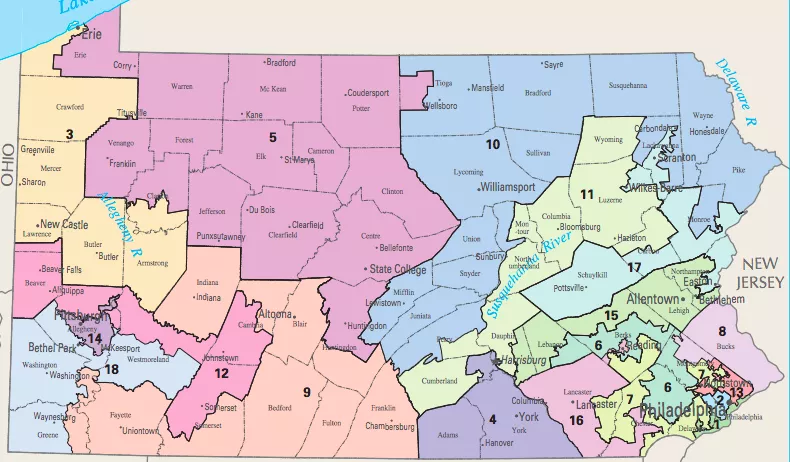
    “Goofy Kicking Donald” was but one of the jokes elicited by the erratically drawn Republican map of Pennsylvania’s congressional districts. (Please see the image.) Widely considered one of the nation’s most blatant cases of gerrymandering – whereby electoral districts are distorted to unfairly favor a given political party – it helped Republicans secure 13 of the state’s 18 districts. To put this in context, our state voted Democratic in presidential elections from 1992 until the disaster of 2016.

    Now, a successful challenge led by the League of Women Voters to correct this imbalance has prompted a legal and political battle, making frequent headlines in the national news.

    Specifically, the League’s June, 2017 suit prompted the Pennsylvania Supreme Court to rule on February 7th that the Republicans’ map violated the state’s Constitution and must be redrawn. Harrisburg was given an ultimatum to either come up with a more equitable map or face a Court-ordered redesign conducted by an outside expert. Harrisburg’s lame response led the Court to adopt a new map, created by Stanford University Professor Nathaniel Persily, a top election law scholar, previously selected by courts for redistricting work in five other states, including North Carolina. (No outsider, Prof. Persily taught at U Penn Law from 2000 to 2007.)

    When it comes to the new district for Bucks County, we gained a section of Montgomery County west of Sellersville that typically votes Democratic. According to Nate Cohn’s “The Upshot” in the February 22nd edition of the New York Times, this slight change flips us from “leaned Trump” to “leaned Clinton”, based on the 2016 presidential results. Cohn concludes that Republican Brian Fitzpatrick’s prospects in the 2018 congressional election exemplify “The sort of race that could be decided by the subtle shift ordered Monday.”

    In retaliation, the Republicans in Harrisburg filed both a motion to Stay the imposition of the new map with the US Supreme Court, and a suit to overturn it on US Constitutional grounds, with the Federal District Court. The legal action now centers on the request for Stay (filed by the State Speaker of the House and President of the Senate) and the suit (with several Republican Congressmen as plaintiffs).

    Both cite the election clause in the US Constitution stating that the “Times, Places and Manner of holding elections for Senators and Representatives shall be prescribed in each State by the Legislature thereof….” and contend that the Court’s action in imposing its plan violates that Clause. The suit quotes voting specialists (including Cohn) that the new PA Court-ordered plan is partisan in its result.

    Democrats maintain that the various Republican maps violate the PA state constitution’s requirement for fair elections. Since the State’s Supreme Court gave our Republican-dominated legislature the opportunity to correct this imbalance, and it failed to do so, the Court was within its rights to call upon a widely recognized independent expert to put it right.

    In sum, we are caught in a Catch-22. If the Constitution prevails over our state’s doctrine, then the shape of our voting districts – and thus, to a great extent, the electoral outcome — will be set by a legislature seeking to secure its dominance well into perpetuity. Truly responsive government, with elected officials who care about our everyday issues, as well as combating climate change, economic inequality, and discrimination, is founded on fair and open elections.

    CALL TO ACTION: Support Fair Districts PA: Fair Districts promotes legislation to place an independent citizens’ commission in charge of redistricting.