INDIVISIBLE Lambertville NJ / New Hope PA

Author: Indivisible Lambertville / New Hope

  • Turning Fear Into Fire – Editor’s Note

    Turning Fear Into Fire – Editor’s Note

    “I am listening to what fear teaches.” Audre Lorde   

    “There is no time for despair, no place for self-pity, no need for silence, no room for fear.” Toni Morrison   

    I may be accused of taking these two quotes out of context, but certainly, we can feel the appropriateness to the moment we are experiencing now. As progressives and activists, this turning away from the values we hold close feels like a slap in the face. A sense of disequilibrium settles into suspicion, words bottled up that burst out in a flood of expletives and sometimes accusations, a desire for payback to those enablers and supporters of all that we stand against. I love Michelle Obama, but right now, going high when I am flattened is a lot to ask. 

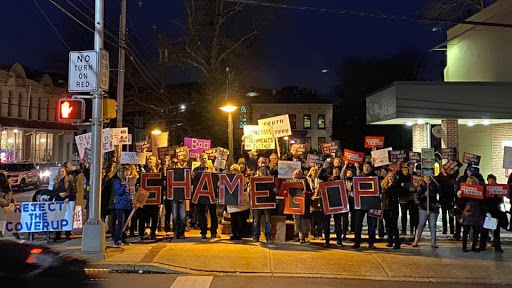
    We gather on the corner of Bridge and Main to protest, but more, we gather because right now, we need each other. We need the company of decent, caring people who are determined to fight this erosion of democracy. 

    It’s okay to feel that fear, anger and dismay, but more importantly, let that be the fuel to the fire of action. What scares you more? Talking to strangers about voting, or watching democracy crumble before your eyes? What’s a better use of time? Clicking ‘like’ or ‘angry’ on some post on Facebook, or clicking MoveOn texts to hundreds to encourage them to support a progressive, Democratic candidate or policy? 

    There is a place for you and you are so needed to help right this ship. Check out the list of opportunities under “Join the Action” in this edition and soon on the ILNH website. Hear from Karen Gaffney, urging us to confront the danger of the false beliefs of race. Read the personal experiences of long-time resisters and a dynamite book review of American Carnage. Catch up on what’s happening in NJ and PA, and come to the Love Mother Earth 2020 event at the end of the month. Last but not least, if you haven’t read the NYTimes piece about Change The Conversation featuring some of our ILNH leaders, the link is below. 

    These are our values in action. Jump in, turn that fear into fire. 

    Love to all, Deb

  • Why the False Belief that Race Is Biological Needs To Be Confronted

    Contributed by Karen Gaffney.

    As a white, anti-racist educator and author, I have been working with white people for years to address the myth that race is biological. What exactly is this myth? It is the belief that human beings can be biologically or genetically or otherwise scientifically divided into distinct races. It is the belief that white people share more genes with each other than they do with black people. It is the belief that you can draw clear scientific lines between racial groups. 

    None of these beliefs are true. Not only are these beliefs false but they are also dangerous. To begin, why are they false?

    Human beings, regardless of where on the planet they live, are about 99.9% genetically identical. The tiny part that does vary does not correlate with race. The PBS documentary Race: The Power of an Illusion (from 2003 but still very relevant) does an exceptional job of explaining that human beings are a very genetically similar species (compared to penguins or fruit flies) and that there are no genetic traits that can be found in everyone of one race and no one of another race. Within any given race, there is genetic variation, often more variation than between racial groups.

    We tend to think that a random white person has more in common with another random white person than with a random black person, but that is simply not the case. There are genes that influence some easily observable differences between humans, and there are genes that influence differences between humans that are not easily observable. Of the easily observable differences between humans, we have been taught to focus on skin color, almost at the expense of all other possible observable and less observable differences. However, the genes that influence skin color do not correlate with the majority of other traits, like intelligence, athleticism, criminality, and perseverance. 

    We need to recognize that the belief that race is biological is not some abstract or intellectual endeavor. It is a matter of life and death. The false belief that race is biological is dangerous for several reasons:

    • This false belief, which scholars thought would fade over time, has seen a dangerous resurgence, as Angela Saini makes clear in her book Superior: The Return of Race Science (Beacon Press, 2019), which highlights connections between this ideology and the rise of white nationalism in the US and globally.
    • The myth that race is biological is also dangerous because of what is known as medical racism. There is ample evidence that black people are often not treated as well as white people when they encounter the healthcare system, leading to a high black maternal mortality rate and a persistent belief that black people don’t feel pain as much as white people do, a belief that served as a rationale for slavery and corresponds to the racial ideology that black people are not fully human. Dorothy Roberts provides an excellent overview of medical racism in her Ted Talk “The Problem with Race-Based Medicine” and elaborates more generally on the danger of the false belief that race is biological in her book Fatal Invention: How Science, Politics, and Big Business Re-create Race in the Twenty-first Century (The New Press, 2012).
    • The belief that race is biological is an excuse for inequality, a way to accept racially disproportionate prison sentences, wealth, housing, and health outcomes as simply a result of biology rather than systemic racism. 

    My college students, when we discuss the ideology that race is biological, often say they are shocked to hear that race is not biological because their prior schooling never raised this issue and because there are many ways in which the media advertently or inadvertently reinforces this myth. In my experience, once students realize that this belief is indeed a myth and that race is actually a social construct, a human invention, they want to spread the word. Likewise, when I facilitate workshops in the community, either at libraries or churches, and I raise this issue, some white participants in particular share their surprise at hearing this myth is not true, and the older they are, the more concerned they are that it took so many decades for them to learn that this belief is a myth. I’ve been working with a NJ-based social justice theatre company, The Meta Theatre Company, and we created an interactive performance called “Dismantling the Myth that Race is Biological” in order to raise these exact issues and highlight medical racism in particular. 

    The more white people understand that race is not biological, the better, so spreading awareness and sharing resources to help debunk the false belief is important. Then, white people in particular need to work on examining the systems we work in to see how the myth pervades the structure of our work, whether it’s embedded in policy, decision-making, etc. We need to confront this myth, debunk it, recognize its impact, and dismantle it. 

    Karen Gaffney, PhD, is an English Professor at Raritan Valley Community College in New Jersey and the author of Dismantling the Racism Machine: A Manual and Toolbox (Routledge). Her book and her website (https://dividednolonger.com/) expand on the ideas presented here. 
  • Just the Facts!

    Contributed by Olga Vanucci.

    • There are about 48 million African-Americans, which is nearly 15% of the U.S. population.
    • 74% of blacks say that being black is important to how they think about themselves.
    • There are 14.8 million black households; 6.1 million of them own their homes, 8.7 million rent.
    • About 20% of blacks have a college degree and over 50% of blacks have attended college.
    • 2.1 million blacks have advanced degrees (master, PhD, JD or MD).
    • 15% of blacks have annual household incomes over $100k; 40% have incomes between $35k and $100k; 25% have incomes between $15k and $35k; 20% of black families live in poverty (current US poverty threshold is $25,100).
    • 6.2 million blacks work in management, professional and related occupations, including 960,000 working in education and 250,000 in the arts; 4.6 million work in service occupations; 4.3 million work in sales and office occupations; 4.2 million work in production, transportation, construction and maintenance.
    • There are some 90,000 black doctors and 73,000 black lawyers.
    • There are 2.6 million black-owned businesses. 
    • There are 53 blacks in the U.S. House of Representatives and 3 black senators.
    • There has been 1 black U.S. President.

    Sources:  https://blackdemographics.com/

    and https://www.pewresearch.org/fact-tank/2019/02/08/for-the-fifth-time-in-a-row-the-new-congress-is-the-most-racially-and-ethnically-diverse-ever/

    and  https://www.bls.gov/cps/cpsaat11.htm

    and https://www.pewsocialtrends.org/2019/04/09/the-role-of-race-and-ethnicity-in-americans-personal-lives/

  • Join the Action Challenge!

    Commit to doing at least one or more actions each week between now and November 3. Here are a few options you can do at home, with friends over coffee or wine, or out in the street loud and proud. Have more ideas? Let us know and we’ll add them to the list. We’re working on a way for you to record your time or number of items (postcards/texts) and turn them into a collective graphic to demonstrate the awesome power of ILNH activists, so keep track and we’ll let you know when that’s ready. (PS – we’d welcome any among you of the technologically inclined that have a great idea how we can do this efficiently). 

    As the shoe guys said, JUST DO IT! 

    • Payback project: Indivisible.org – focuses on nine vulnerable Senate Republicans up for re-election. If you’re not in one of the nine Senators’ states, you can sign up through the project to text voters for GOTV, donate to the ad campaigns that will run in those states
    • Resistbot: Text “Resist” to 50409 and Resistbot finds out who represents you in Congress or your state legislature, turns your text into an email, fax, or postal letter, and delivers it to your representatives. 
    • MoveOn Texting – Be social and/or independent; ILNH is organizing we-text Wednesdays – a weekly MoveOn Texting social opportunity. We’re still working on the location, and if you’d like to host one, contact Kati Kertez. But don’t wait, you can easily knock off hundreds of texts in as little as 15 minutes anywhere you have an Internet connection (I used to do mine while on conference calls).  
    • Vote Forward: Letters to Voters – Vote Forward is a 501(c)(4) nonprofit organization. Our mission is to empower grassroots volunteers to help register voters from under-represented demographics and encourage them to vote. We build tools to enable Americans, wherever you live, to get unlikely-to-vote fellow citizens to the polls.
    • Postcards to Voters: Send friendly, handwritten reminders to targeted voters giving Democrats a winning edge in close, key races coast to coast.
    • Change the Conversation Together: Deep canvassing focused in Bucks County to flip the district, but these skills are important for anyone who’s serious about getting Democrats elected. Share values instead of talking points to find common ground. Contact Susan Shapiro or check the Change the Conversation Bucks Facebook page for upcoming workshops and trainings.  
  • From the NJ Statehouse: The Good, the Bad, the Missed, and What to Watch for Next

    From the NJ Statehouse: The Good, the Bad, the Missed, and What to Watch for Next

    Contributed by Amara Willey and Liz Glynn.

    Big win in NJ legislative session for ACA protection

    For residents of NJ, there’s good news coming out of Trenton for a change that should have progressives cheering. There’s always a but, however, and other legislation didn’t make the cut and some that did isn’t quite what we hoped. So here’s the good, the bad and missed, plus be sure to check out what’s coming up in this next session.

    The governor signed 80 percent of the bills that had passed both houses. These included a bill banning flavored vaping to reduce its appeal to children, a requirement that health insurance companies provide a choice that limits prescription drug costs to insureds, and the creation of a telephone hotline for state employees to confidentially report incidents of workplace harassment or discrimination. The 33 unsigned, or pocket-vetoed, bills included tightened regulations for tobacco and vaping sales, allowing preserved farms to hold 14 special events a year and requiring the installation of automatic fire sprinkler systems in new townhouses.

    The Good

    Happily, the majority of the ACA Protection Bills passed this session – paving the way to protect NJ patients from the GOP sabotage on the federal level. In addition, important policies have passed to advance racial justice and support working people, including driver’s licenses for all, voting rights restoration, expungement of marijuana offenses, and ending prison gerrymandering.

    The ACA Protection Bills are a set of critical bills that create the safety net we need and protects NJ patients from the potential loss of guaranteed coverage for essential health benefits such as preventative care, treatment for substance use and mental health, and reproductive health services, and loss of protections for pre-existing conditions. Here’s a list of actual ACA Protection bills that have passed: 

    S562/A5248 – Preserves certain requirements that health insurance plans cover essential health benefits
    S626/ A1733 – Prohibits pre-existing condition exclusions
    S3802/A5501 – Requires continuation of dependent coverage until age 26
    S3803/A5507 – Requires health benefits coverage for certain preventative services
    S3804/A5508 – Revises the law requiring health benefits coverage of contraceptives
    S3806/A5503 – Establishes open enrollment period under the Individual Health Coverage Program
    S3808/A5506 – Repeals NJ’s Basic & Essential health benefits plans to conform to ACA
    S3809/A5500 – Expands rate review process for individual and small group plans
    S3812/A5504 – Applies 85% Medical loss ratio requirement to large group plans

    Other:

    • Online Voter Registration A422 modernizes our outdated process and allows easy online access for voter registration to increase participation in our democracy and improve accuracy.
    • Ending Prison Gerrymandering A1987 stops the outdated process of counting incarcerated people as residents of their prisons for the purpose of redistricting and will now count them as residents of the communities from which they have come to restore the voices and resources of their communities.
    • Maternal Health Bill A4934/S3374 extends and expands Medicaid coverage of postpartum women at a medically complex time to ensure the support and health of mothers and their children.
    • Voting Rights Restoration A5823/S4260 restores the right to vote to people on parole and probation and will increase participation in democracy and reinvigorate civic participation.
    • Driver’s Licenses for All A4743/S3229 ensures road safety and access to driver’s license for immigrants to thrive in our communities and take care of their families. 
    • Marijuana Expungement bill A5981/S4154 clears past criminal convictions of marijuana offenses and allows people with a record the opportunity for a clean slate to improve their lives.
    • Marijuana Ballot Question passed with more than three-fifths voting yes, and is now on the ballot for the November 2020 election. (https://apnews.com/372117448cd3dfbb415b1a67204a71b3)

    The Bad

    • S3770 passed which creates a Path to Progress Committee in the legislature. This bill establishes a 12-member “New Jersey Economic and Fiscal Policy Review Commission” in the Legislative Branch of State government. This legislation implements a proposal in the New Jersey Economic & Fiscal Policy Workgroup’s “Path to Progress” report. The commission will be composed of six members of the Legislature (three from the Senate, three from the Assembly) and six public members. Senator Sweeney will be able to pick the Senators and influence the selection of the other appointees. 
    • S3813/A5510, which would have expanded the “Law Against Discrimination” to apply to health programs and activities, and to prohibit discrimination based on association with individuals in protected classes. It passed in the Senate, but strangely, didn’t get voted on in the Assembly.  To date, and we haven’t received a reasonable answer as to why.  
    • A3783 Railcar Safety would have required trains to have discharge response, cleanup, and contingency plans to transport certain hazardous materials, including fracked oil, by rail. Passed in the Senate but didn’t get voted on in the Assembly.

    Missed Opportunities:

    • Bag Ban
    • Redistricting Constitutional Amendment
    • Green Amendment – constitutional amendment
    • Corporate Tax Credit Reform
    • Marijuana Decriminalization
    • Environmental Justice – S1700/A5094 Giving NJDEP authority to just say no to new pollution in already overburdened communities
    • ACA Protection Bills:
      • S3811/A5502 – Revises definition of small employer under New Jersey Small Employer Health Benefits Program.
      • S3813/A5510 – Expands “Law Against Discrimination” to apply to health programs and activities, and to prohibit discrimination based on association with individuals in protected classes
      • S3810/A5505 – Revises certain permissible rating factors for premiums charged for individual and small employer health benefits plans. 

    Bills to Watch In this Next session:

    • Fair Work Week
    • Lowering Prescription Drug Prices
    • Coverage for All Kids
    • Annual Budget process – push for raising revenue with the package of proposals that Gov Murphy included in his budget but was rejected in legislature includes millionaire’s tax plus estate tax, sales tax, gun permit fees, opioid manufacturers tax, etc.

    Sources:

    New Jersey Citizen Action Newsletter (Liz Glynn)

    https://whyy.org/articles/gov-murphy-signs-151-new-bills/

    https://www.nj.com/marijuana/2019/12/new-laws-will-clear-nj-criminal-records-for-weed-and-allow-people-on-parole-to-vote.html