INDIVISIBLE Lambertville NJ / New Hope PA

Author: Indivisible Lambertville / New Hope

  • Just the Facts – Unions

     Contributed by Olga Vanucci.

    • Fifty years ago, nearly a third of U.S. workers belonged to a union. Today, it’s one in 10.
    • On average, a worker covered by a union contract earns 13% more in wages.
    • Unions have transformed once-low-wage jobs in hospitality, nursing, and janitorial services into positions with living wages.
    • When the share of workers who are union members is relatively high, wages of nonunion workers are higher.
    • Union members are 18% more likely to vote in presidential elections than non-members, 43% more likely to volunteer for an election campaign, and 73-93% more likely to participate in protests.

    Sources:  https://www.npr.org/sections/money/2015/02/23/385843576/50-years-of-shrinking-union-membership-in-one-map

    and https://www.epi.org/publication/how-todays-unions-help-working-people-giving-workers-the-power-to-improve-their-jobs-and-unrig-the-economy/

  • Census in the Time of Corona


    Contributed by Elaine Clisham.

    As if this year’s decennial census didn’t have enough challenges — the first census conducted largely online, delays in systems security testing, budget shortfalls, the court fight over the citizenship question — now the census has to contend with the restrictions imposed by a pandemic. Which means of course some things have changed.

    First, the good news: As of May 2, 2020 when this is being written, the national online response rate to the census was 56.3%. That’s higher than census officials had predicted. Here’s how we stack up locally (and if you want to play around with the interactive map of response rates, you can find it here):

    National Self-Response Rate: 56.3%

    Response Rate Response Rate
    New Jersey 58.1% Pennsylvania 58.5%
    NJ-07 68.6% PA-01 68.0%
    Hunterdon County 68.0% Bucks County 67.8%
    Lambertville 66.9% New Hope 58.8%

    So how do we get from here to 100%?


    The people who have responded so far are the ones most likely to respond anyway, regardless of whether it’s online, by mail, or in person. Now we need to look for the hard-to-count groups. They are who you might expect:

    • Young people 18-24
    • Renters
    • People living in poverty
    • People who don’t speak English
    • Migrants and minorities

    But we also need to worry about families with children age 4 and under; people who live in gated and access-controlled communities where census workers will have trouble reaching them; and people who struggle with technology. 

    In light of the pandemic, the Census Bureau has reset some deadlines. Field staff training won’t begin until at least June 1, in-person visits won’t begin until at least the second week in August, and the final response deadline has been postponed four months, from June 30 to October 31. (So you still have time!)

    Most importantly, the Census Bureau has asked Congress (and it takes an Act of Congress to do this) to postpone by four months, from March 31, 2021 to July 31, 2021, the deadline by which it has to deliver to states the data that will be used for Congressional and legislative redistricting. For Pennsylvania, this will have a marginal effect, since Pennsylvania won’t need to reapportion its districts until the 2022 elections.

    But for New Jersey, that four-month delay is critical, since New Jersey needs to reapportion its legislative districts in time for 2021 elections. And the potential new data deadline of July 31, 2021 is later than our usual primary date! 

    So what’s going to happen? We don’t know. Gov. Murphy was asked about this at a recent press conference, and acknowledged he “hadn’t given it one second’s thought.” Right now, here are New Jersey’s deadlines:

    • Redistricting Commission must be appointed by November 15, 2020 (you can learn more about how the governor appoints the commission here).
    • Legislative districts must be redrawn 30 days after receiving data (in 2011, data was received Feb. 3; in 2021, if the Census Bureau gets its extension, data might not be available until July).
    • Legislative candidate filing deadline: April 15, 2021
    • Primary: June 8, 2021 (we think)

    Secretary of State Tahesha Way leads New Jersey’s Complete Count Commission, so it will probably fall to her to make a recommendation.


    And it turns out, if you filled it out incompletely or incorrectly, you can go back and resubmit your answers! So, if another human joined your family between when you completed the census and April 1, 2020, which is the country’s official Census Day, you can add them. 

    And if you added your college-student child because they were home on April 1 even though they are usually away at school, you can remove them. For students who go to college away from home, the college works with the Census Bureau to count students in residence. So, pretend they’re still at college when you fill out your form.

    And finally, if you know someone in a hard-to-count group, do what you can to help them get counted. Because when it comes to the census, there’s strength in numbers.

    More resources:
  • The Masked Resisters: When Duty Calls, ILNH Answers

    The Masked Resisters: When Duty Calls, ILNH Answers

    While much of our ILNH mission calls on us to demonstrably support or oppose political actions or proposals in or out of sync with our values, there are times when a true hands-on, material approach is the activism most needed.

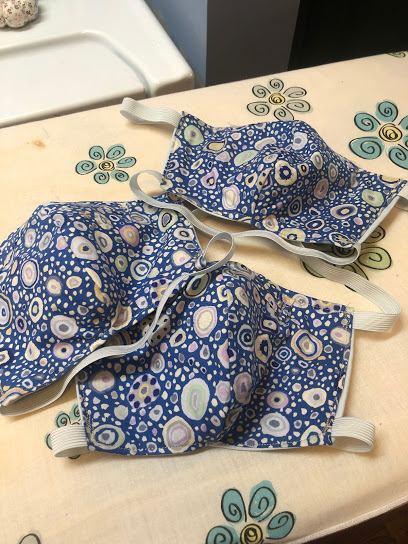
    And so it was – and is – with the Mask Brigade, a growing team of Indivizzies who jumped into mask making to help protect front line workers and the broader community during the pandemic. 

    As the high demand for PPE – personal protective equipment – skyrocketed past the limited supply,  even hospitals were hard pressed to equip doctors, nurses and others in direct contact with coronavirus patients. Those with sewing machines and those without formed an appropriately socially-distant assembly line of donators, cutters, sewers and distributors. 

    Donations of material came from everywhere: bags of fabric waiting for purpose in the back of closets, old sheets, leggings to add comfort to elastic earpieces. Mask patterns in various styles were gathered and shared along with tips for producing in quantity. Cutters cut in layers, leaving the flat pieces on porches for pickup by the next line. Wire twisters twisted nose pieces. One of the Brigade’s de facto captains,’ MJ Legere, put together bags of fabric, wire and elastic, left in a blue tub on her porch for pickup by sewers. Sewing machines became permanent fixtures on dining room tables, some retrieved from attics or in-laws and handed off to those with time or skill to put thread to fabric in a usable form.  

    Stories of successful scrounging and sharing emerged: ILNH Board president, Susan Shapiro, found a light bulb in her mother’s old sewing box (left prior to 1979), that perfectly fit Elaine Clisham’s mother’s sewing machine, which was then handed off to MJ’s neighbor. 

    The relay extended far and wide. For example, Doug Graiver took 170 masks from MJ’s porch to Philadelphia, where they were handed off to a relative and subsequently to an ER nurse at Children’s Hospital of Philadelphia. 

    The Brigade has produced hundreds – if not thousands – of colorful masks given at no cost to clinical staff, all manner of frontline workers, and individuals throughout the greater community. 

    There is no easy way to calculate the hours spent, but in the midst of this crisis, we see Agape in action: the highest form of love as the unselfish concern for the welfare of others. And that is the foundation on which every ILNH action, value and mission is based. 

  • Voting Reform Needed STAT

    Contributed by Deb Kline.

    “THIS IS RIDICULOUS”

    Sign held by a Milwaukee voter waiting to cast an in-person ballot after SCOTUS’ ruling declined to extend absentee voting deadlines.  

    Truer words were never spoken. Never mind that SCOTUS met by videoconference to deliberate the issue. Never mind that the polling locations in Milwaukee had been reduced to five from 180. The current voting system (or should I say systems since each state is responsible for its own) is broken and the time to call for voting reform is now. 

    We have witnessed a steady drumbeat of anti-voter strategies by those who wish to limit whose voice actually counts. Voting methods, requirements and technology vary widely from state to state and sometimes even within counties and municipalities. Numerous election security legislative proposals have been squashed. Polls have been closed or moved and voters de-registered without informing constituents. We’ve been stung by the defeat of the popular vote in favor of the Electoral College and by courts that have been politicized to favor the will of the Federalist Society rather than the will of the people. Did I mention gerrymandering? No, see the piece on REDMAP in this newsletter to add another log to the fire of outrage. 

    We fail to foresee how much lower the depth of Republican political chicanery can go in their ‘winner takes all, democracy be damned’ approach. But it can, and it does. Blinders off, lessons learned the hard way tend to have a profound effect. Our grumbling has become a roar and Congress must take note

    While the current rallying cry is that vote by mail must be an option nationwide. Trump has already signaled that’s not likely to happen from a federal level, saying that it’s ripe for voter fraud (side note that he intends to VBM because he’s allowed). Still, it’s only one piece of a larger puzzle to help ensure free and unfettered elections where everyone gets a voice. 

    Currently, each state is in control of its own voting processes and mechanisms. While it may not be prudent to take total control away from the states, it may be time for a federal standard at least for the duration of this pandemic. The “I have a plan for that” former presidential candidate, Elizabeth Warren outlines much of what was dismissed out of the third stimulus package, but calls for support in the next and upcoming legislation:  

    • Expand online voter registration so it’s an option in every state, extend voter registration deadlines as much as practicable, and let any eligible voter register on Election Day.
    • Make states provide at least 30 days of early voting to help reduce crowds and maintain access to safe, in-person voting.
    • Mail every registered voter a ballot and a postage-paid return envelope. That way, they can safely fill it out at home, send it back in, and participate in our democracy.
    • Ban states from purging voter rolls during this pandemic — unless a voter has come forward and said they want to be removed, or unless there’s objective evidence that their registration is out of date. And states must add voters’ names back to the rolls if they’ve already been purged.
    • Ensure equal access to the polls — regardless of race or ethnicity, language, tribal citizenship, or ability. That includes ensuring sufficient and safe polling places on Election Day, providing accessible ballot machines for people with disabilities, expanding voting hours, and allowing people to vote with a sworn statement of identity instead of an ID.
    • Provide no less than $4 billion in surge funding to states for election administration, compensate every poll worker (including providing hazard pay), and bolster election security.

    CALL TO ACTION

    As an activist, you have to be fired up. If you need one more reason to take action, consider this: Last week, Donald Trump claimed that if we made it easier for more people to vote, “you’d never have a Republican elected in this country again.”

    Enough said? Use the extra time on your hands to demand that these emergency protections be included in the next coronavirus bill. Indivisible National is making it easy for us by providing the tools to get us started, including: 

    • Record a video to demand your senators include Elizabeth Warren’s election protection plan in the next coronavirus bill. Click here to make a video
    • Share our election security resource far and wide. Click here to view.

    Friday, April 17th is an Indivisible Vote By Mail day of action. Mark your calendars and make your voice heard!

    Additional Resources and Reading: 

    Brennan Center for Justice: Why a Vote by Mail Option is Necessary

    Heather Cox Richardson – particularly April 6 for background on Wisconsin’s primary voting debacle, but for a fantastic grounding in current and historical political movements, actions and consequences.

  • State of the State Voting: NJ and PA

    Contributed by Deb Kline.

    States currently have total control over how and when elections are held. While many eyes are on the proposal for national voting changes due to the coronavirus before the US Congress, it must be clear that states need to take or expand action to ensure a fair and robust election. Further, while Vote by Mail is the main focus, according to the Brennan Center for Justice, many states will be hard pressed to make sure enough ballots are ready, shipped and returned in time. Here’s the latest from NJ and PA, plus your call to action at the state level: 

    • Primaries in both states have been moved from their original dates due to the coronavirus. In New Jersey, the primary has been moved to July 7; and Pennsylvania is still on the calendar for June 2. 
    • Vote by Mail:  
      • NJ has allowed ‘no excuse needed’ vote by mail for some time. To receive a ballot by mail, the application must be received by the County Clerk 7 days prior to the election. A voter may also apply in person to the County Clerk until 3:00 p.m. the day before the election.
      • Pennsylvania loosened what was previously among the most restrictive requirements for absentee or vote by mail ballots. While it may seem as if the two are synonymous, the state does differentiate. Registered voters can apply for a mail-in ballot online, by mail or in person at the county election office. Applications for a mail-in ballot must be received one week in advance of the election and turned in by the date of the election. For the June 2 primary, applications for a mail-in ballot must be received by the county election office by 5 pm May 26. For more information on PA absentee and mail-in voting, go here 
    • Early voting: NJ allows in-person early voting 45 days prior to election day ending the day before the election at the County Clerk’s office. In Pennsylvania, however, there is no in-person early voting. Mail-in ballots go out 50 days in advance of the election.  

    It must be noted that the expected increase in vote by mail ballots will undoubtedly put a burden on local officials. In an Op-Ed in NJ Spotlight, David Goodman, team leader of the New Jersey chapter of Represent.Us – a national grassroots anti-corruption movement advocating for election and campaign finance reform, calls for strengthening the paper ballot system by making money available for reliable optical scanning machines and a state-wide standard for mail-in voting across counties. In NJ, two bills need your support: 

    • A- 3591, co-sponsored by Assemblymen Andrew Zwicker and Dan Benson, creates statewide standards for counties to follow. The bill provides protections for the voter and methods to ensure that questionable ballots are retained and adequately inspected. More than that, it would make information available to increase public awareness of voting by mail.
    • The second bill (A-2175) sponsored by Assembly members Raj Mukherji, Annette Chaparro, and James Kennedy, removes barriers to voting. Most significantly, the bill requires the secretary of state to establish a website for online voter registration.

    CALL TO ACTION